
 Facebook
 X
X
 Pinterest
 Copy Link
July 2025 ~ Unlock Equity, Spark Joy & Celebrate!

July 2025 NewsletterJuly is nearly here, and you know what that means—fireworks, family, and a fresh batch of inspiration to make your home sparkle all year long! I’m delighted to bring you this month’s newsletter, filled with practical tips and creative ideas to elevate your space and your equity. Whether you’re cooling off poolside or prepping your patio for the perfect Fourth of July bash, I’ve curated articles that speak to the way we live—and dream—here in beautiful South Florida. This issue, we’re exploring:
Wherever you are on your homeownership journey, I’m here to help you make informed, confident, and creative choices—every step of the way. Wishing you a safe, joyful and fun-filled July! Warmly, |
|||||||||||
National Stories
|
|||||||||||
|
|
|||||||||||
|
Real Estate Updates | Area Reports | May 2025
|



Enjoy your July and celebrate in style! If you are interested in evaluating your home equity, I offer complimentary comparative market analyses to give you a clear picture of your home’s value in today’s SE Florida market. I’m here to help and guide you every step of the way with experience and integrity.
CONTACT ANNETTE
Let’s start working together!

Annette Dammeyer, REALTOR®, ABR®, AHWD®
Coldwell Banker Realty
901 E Las Olas Blvd STE 101, Fort Lauderdale, FL 33301
808.747.3686
SL 3535792
Confused About Your “Home Equity”?
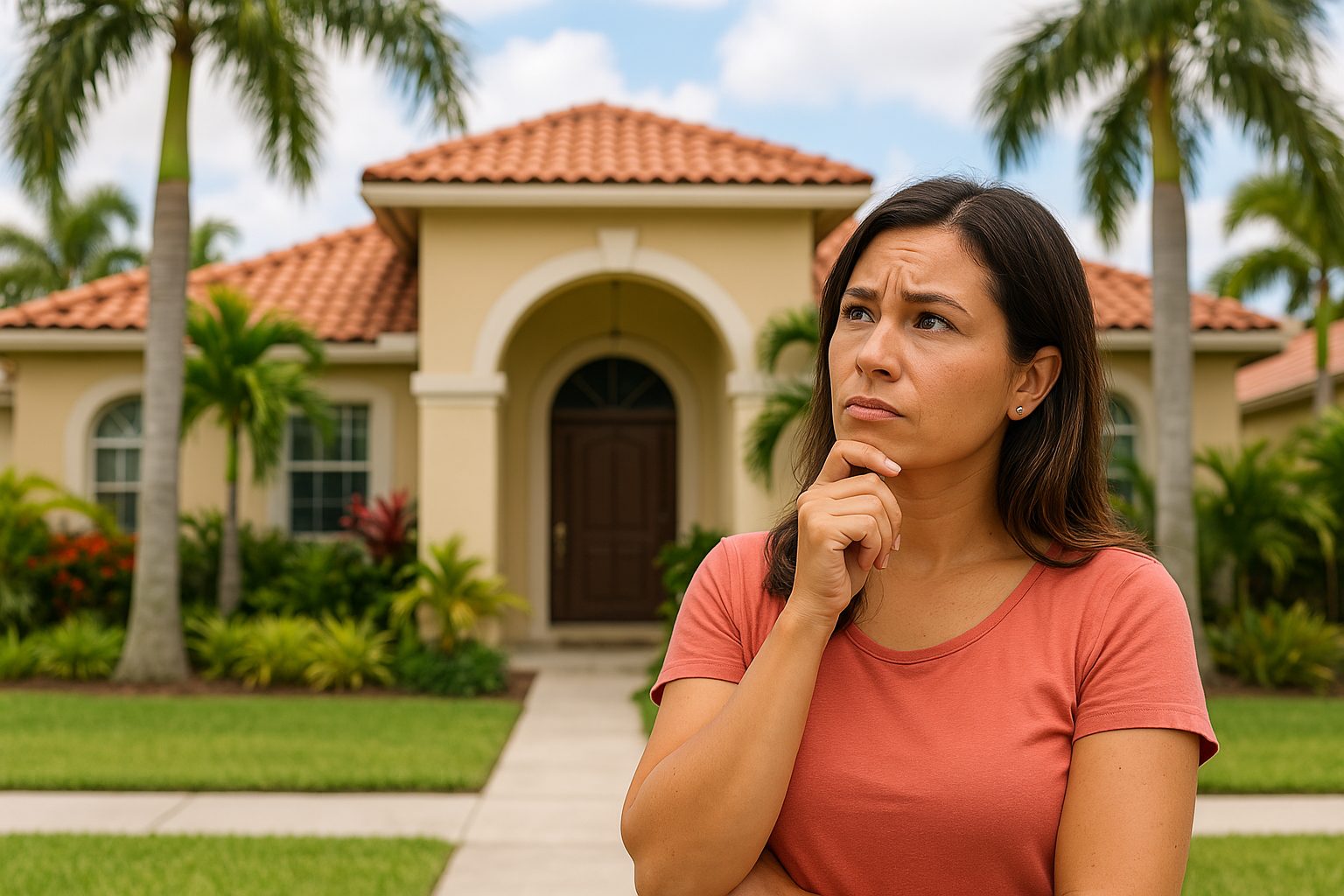
Your Home Equity: What Every SE Florida Homeowner Needs to Know
Understanding Home Equity in Simple Terms
Home equity is the portion of your home that you truly own—think of it as the difference between your home’s current market value and what you still owe on your mortgage. For example, if your home is worth $500,000 and you owe $300,000, you have $200,000 in equity.
Equity builds over time as you pay down your mortgage and as your home’s value appreciates. In SE Florida, where property values can fluctuate based on demand, location, and local market conditions, understanding your equity is crucial for making smart financial decisions.
Factors That Impact Your Home Equity
Several key factors influence equity:
- Home Value – Your property’s worth is determined by market trends, location, and home improvements. Regularly monitoring your home’s value helps you understand how much equity you have.
- Mortgage Payments – Each monthly payment increases your equity by reducing the outstanding loan balance.
- APR (Annual Percentage Rate) – APR refers to the total cost of your mortgage, including interest rates and fees. A lower APR means you’re paying less over time, helping you build equity faster.
- Market Conditions – SE Florida’s real estate market can see rapid changes, influenced by local demand, tourism, and economic shifts. These conditions directly affect your home’s value.
- Home Improvements – Strategic upgrades like kitchen renovations or landscaping can boost your home’s value, increasing equity.
Why Home Equity Matters
Your home equity gives you financial leverage. Whether you’re considering selling, refinancing, or borrowing against it, knowing where you stand can help you make informed decisions.
Get Your Personalized Home Equity Analysis
Want to know exactly how much equity you have in your home? I offer comparative market analyses to give you a clear picture of your home’s value in today’s SE Florida market. Reach out today to get your personalized report and expert insights on maximizing your investment!
CONTACT ANNETTE
Let’s start working together!
Annette Dammeyer, REALTOR®, ABR®, AHWD®
Coldwell Banker Realty
901 E Las Olas Blvd STE 101, Fort Lauderdale, FL 33301
808.747.3686
SL 3535792
Fort Lauderdale May 2025 Area Report
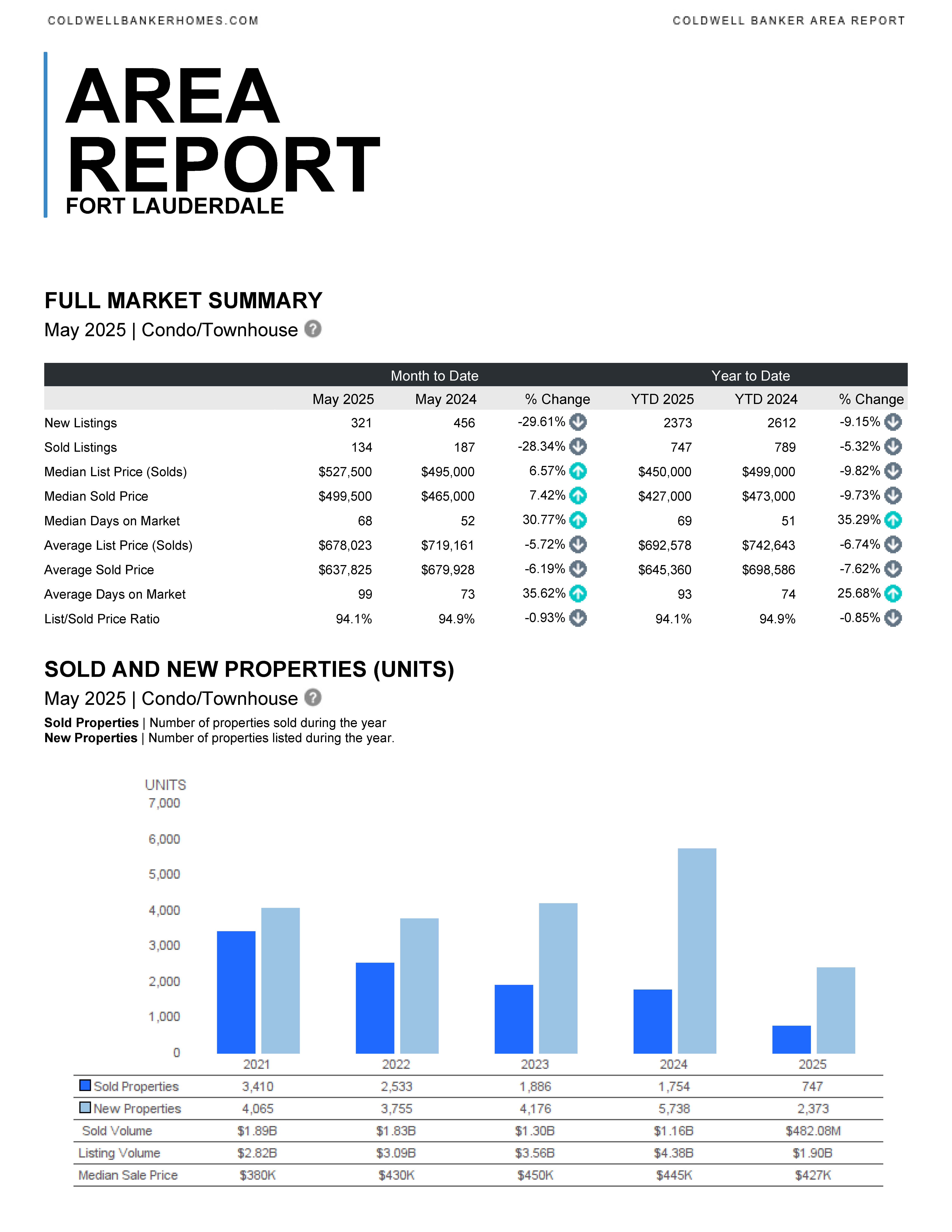
Fort Lauderdale May 2025 real estate statistics have been released.
Fort Lauderdale Area Reports
Single Family Homes
Condominium & Townhouses
Fort Lauderdale Real Estate Market Overview
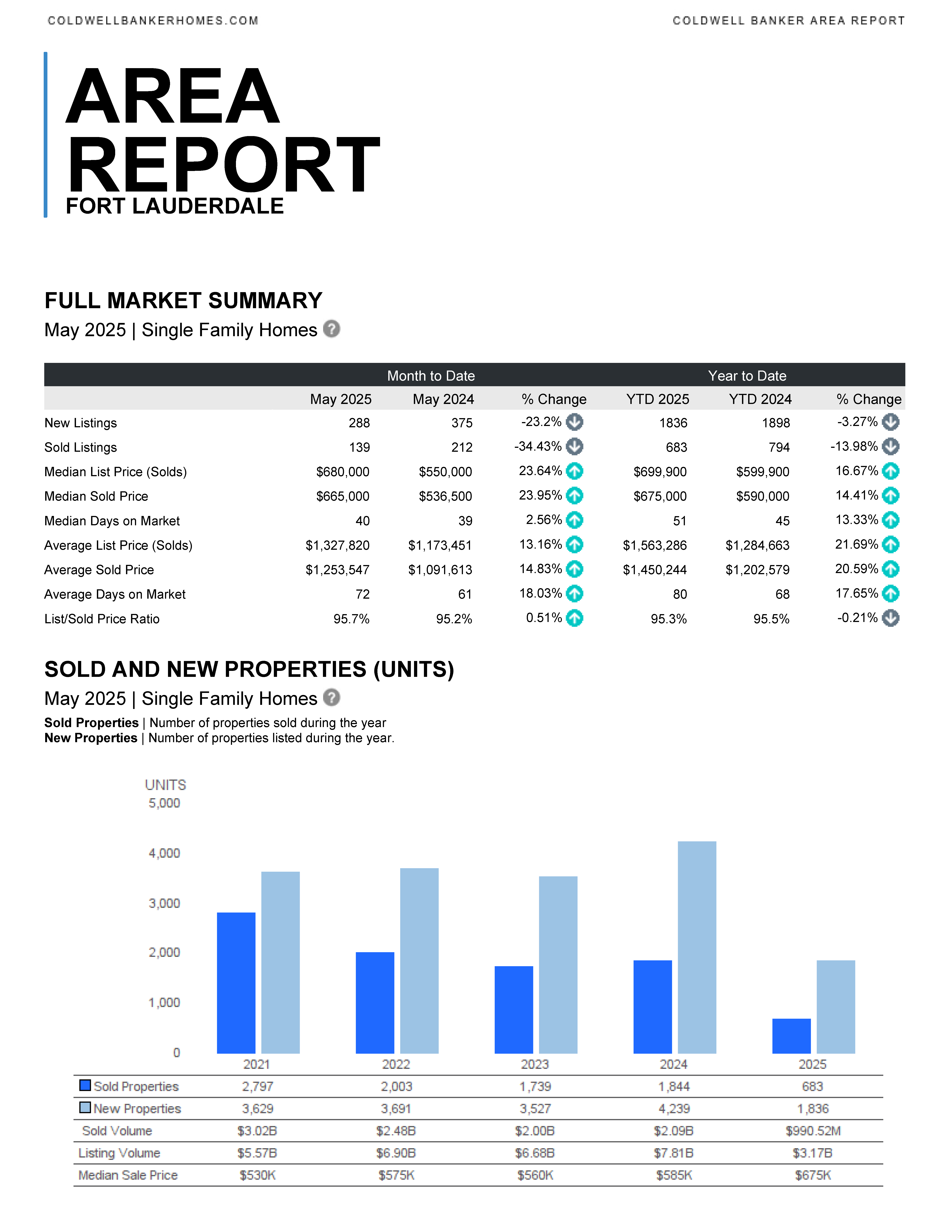
The Fort Lauderdale real estate market has experienced significant changes in sales activity and pricing trends over the past year. Both single-family homes and condo/townhouse markets show a decline in sales volume, while prices have generally increased.
Summary:
Single Family Homes Sales Activity
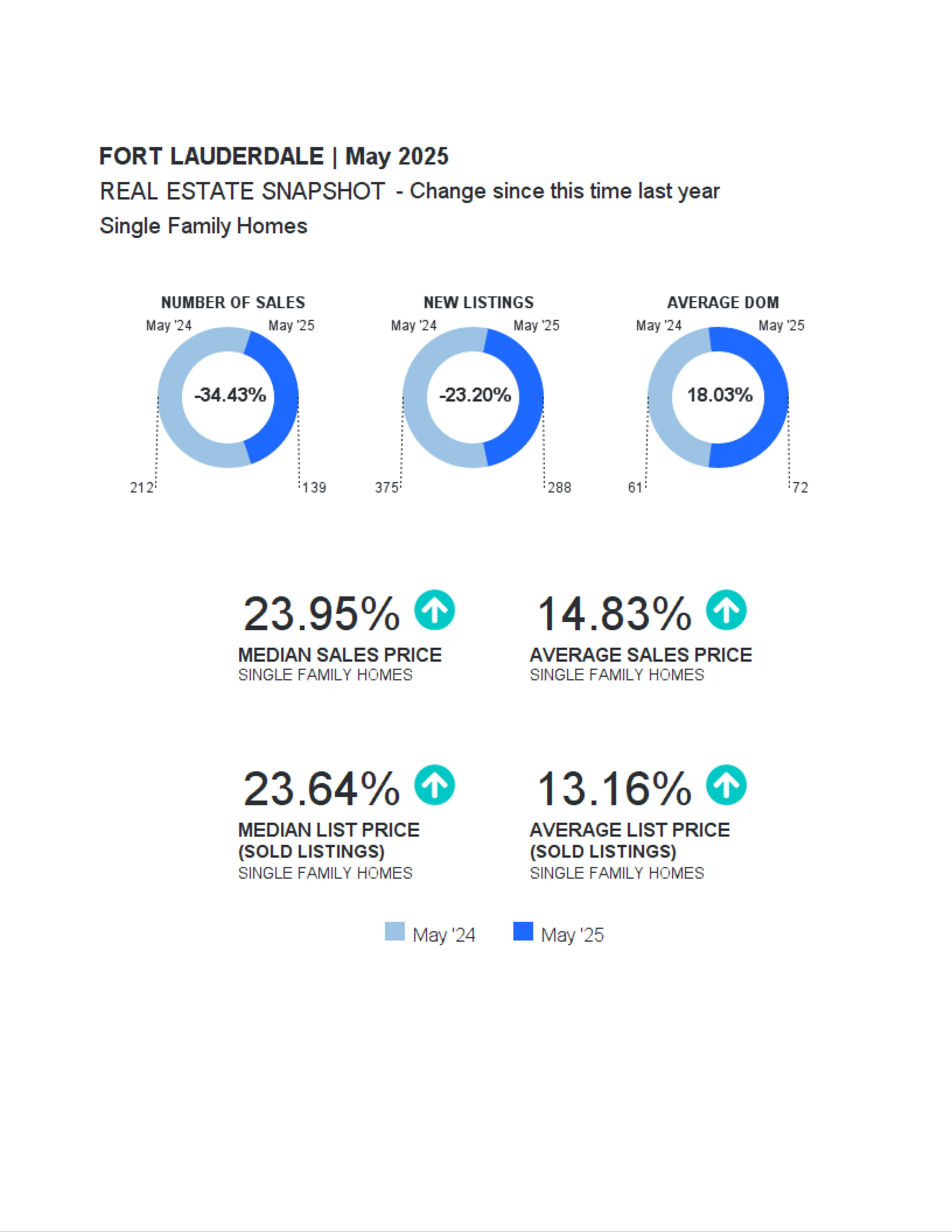
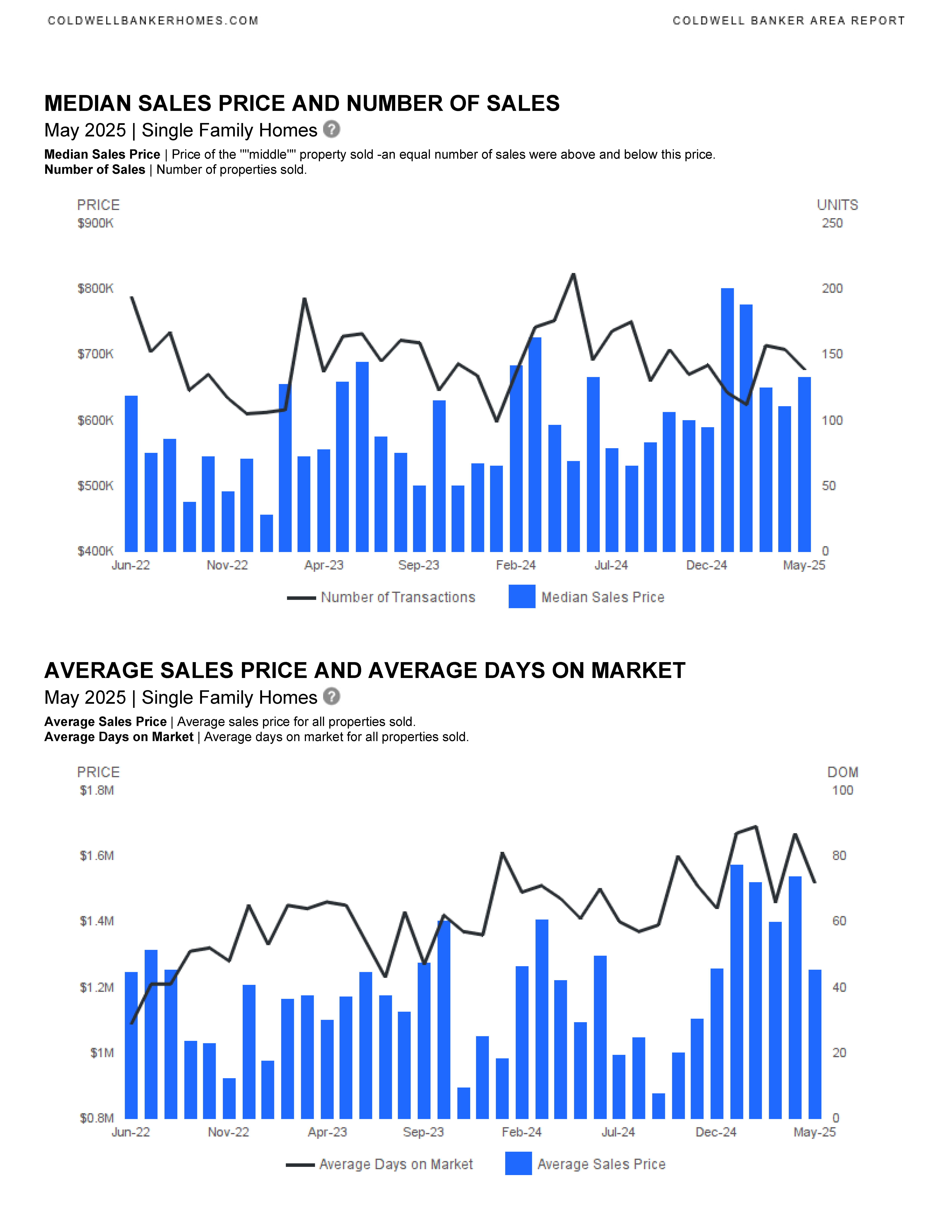
Sales of single-family homes in Fort Lauderdale have decreased significantly compared to last year. The median sales price has risen, indicating a shift towards higher-value properties.
- Number of sales decreased from 212 in May ’24 to 139 in May ’25, a drop of 34.43%.
- New listings fell from 375 in May ’24 to 288 in May ’25, a decrease of 23.2%.
- Median sales price increased by 23.95%, from $536,500 to $665,000.
- Average sales price rose by 14.83%, from $1,091,613 to $1,253,547.
- Average days on market increased from 61 to 72 days, an 18.03% rise.
Condo/Townhouse Market Trends
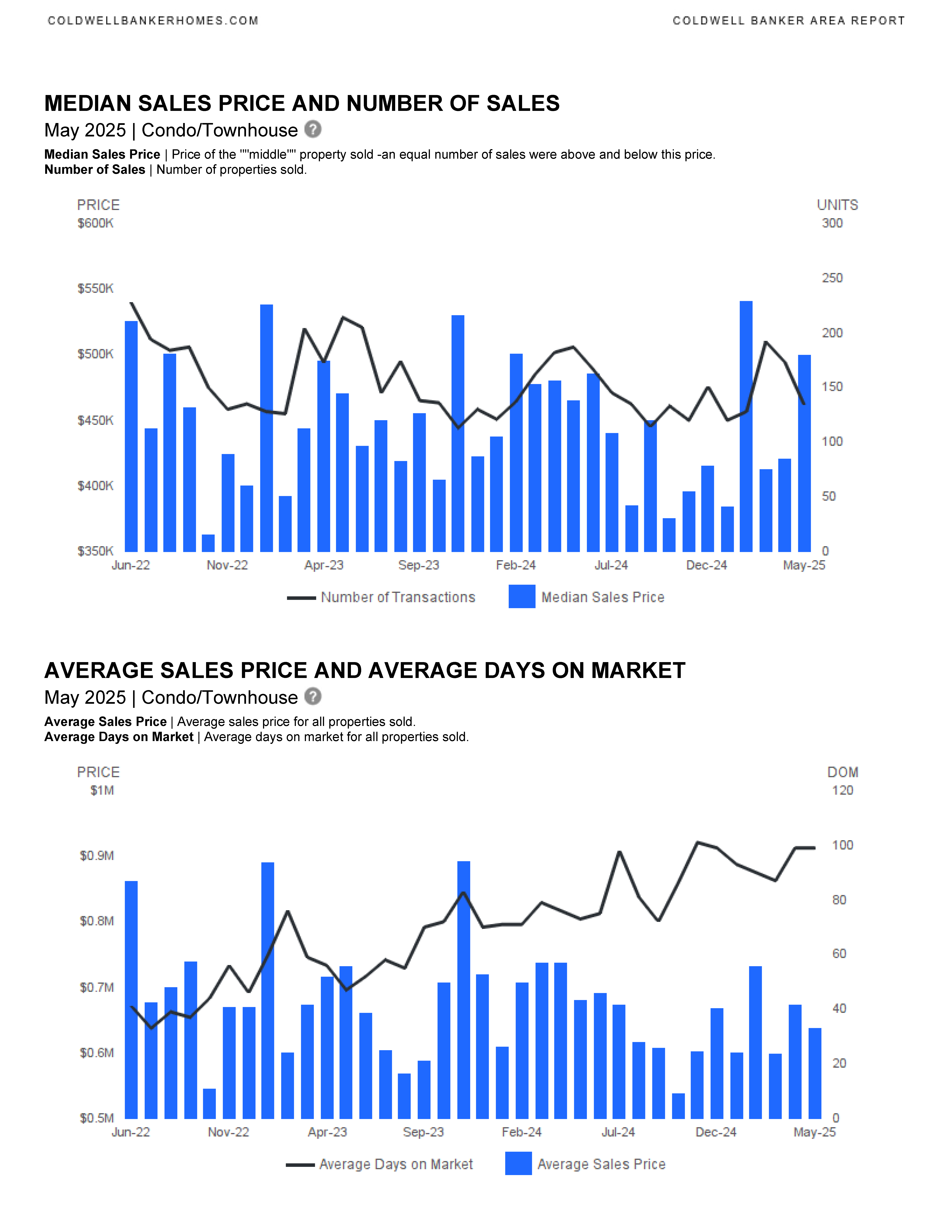
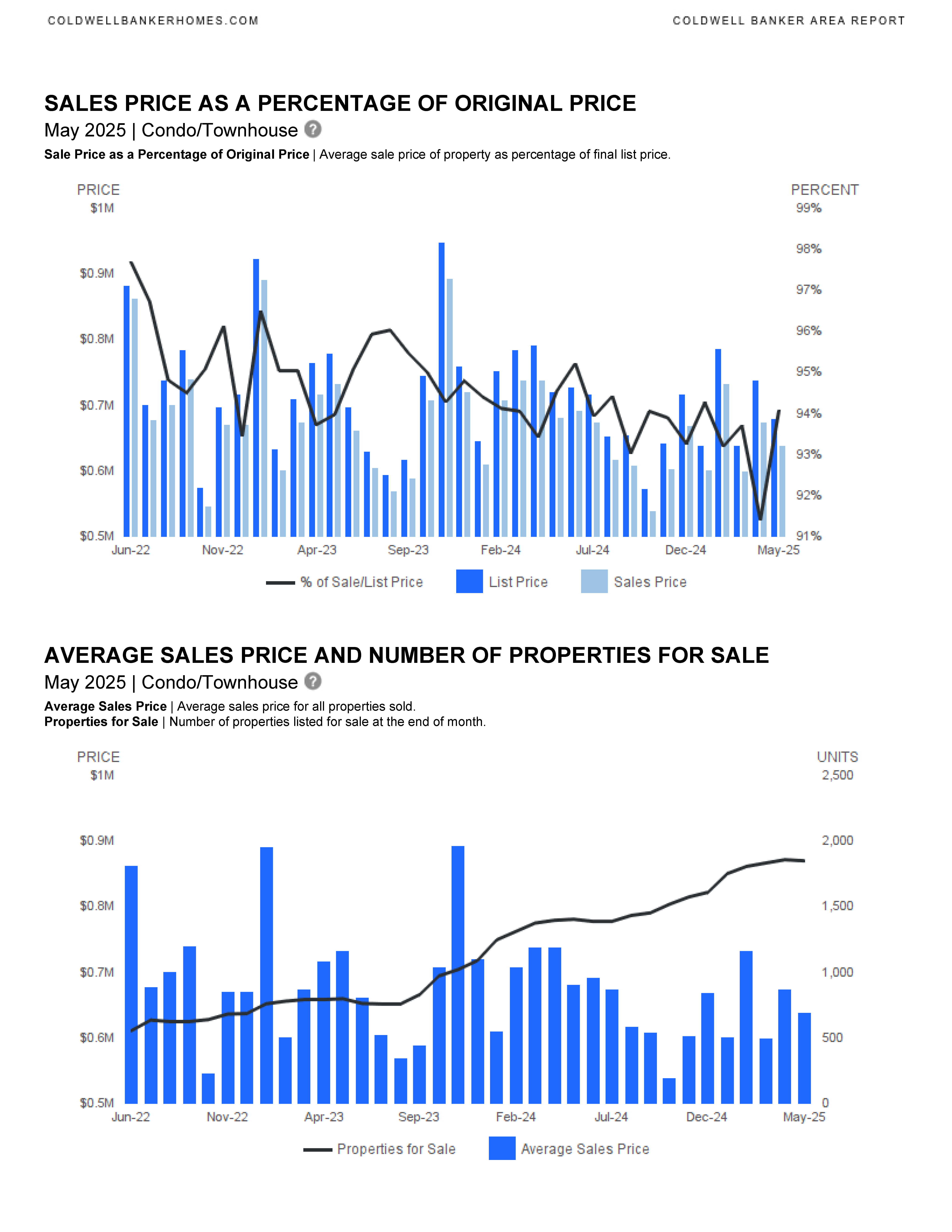
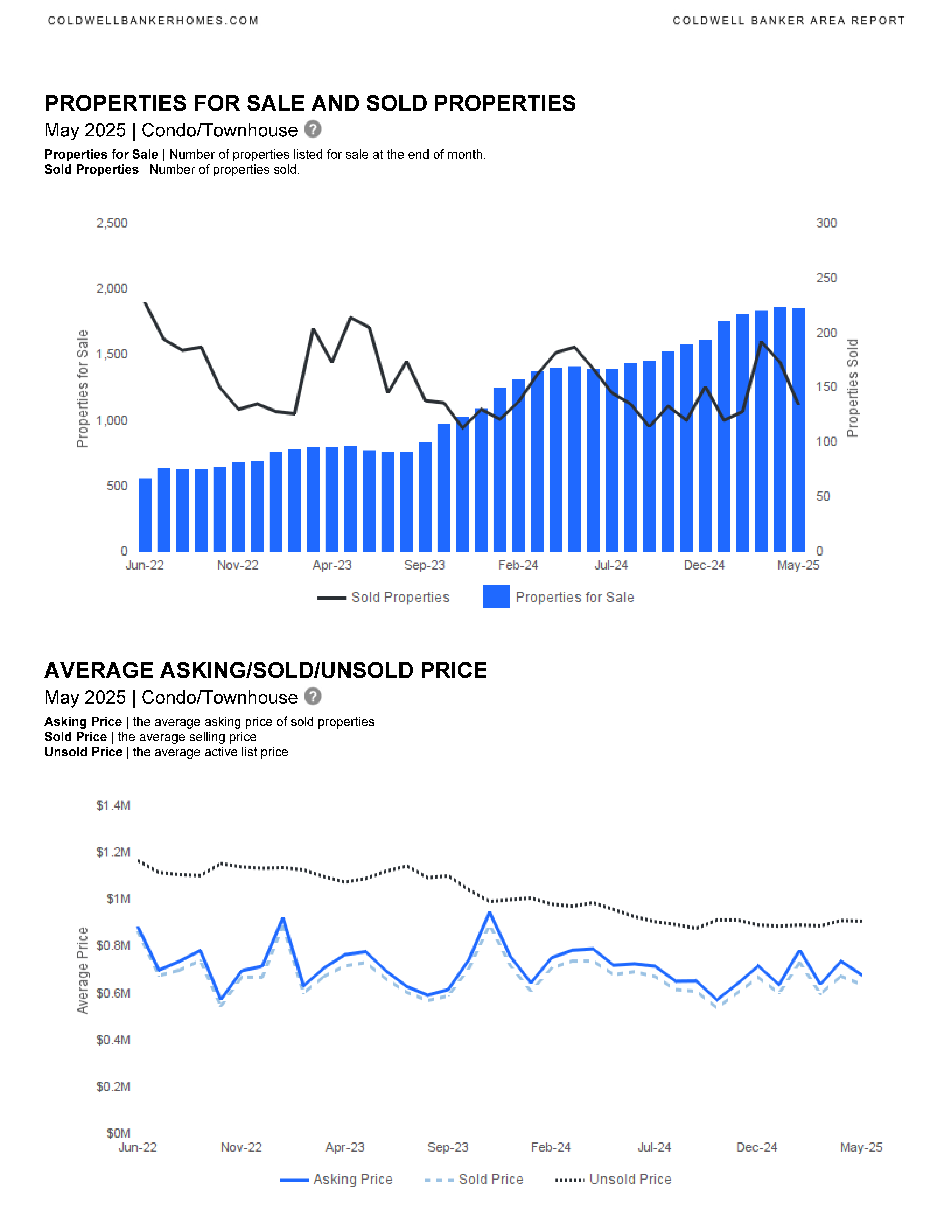
The condo/townhouse market in Fort Lauderdale has also seen a decline in sales, with a slight increase in median prices. This indicates a competitive market despite fewer transactions.
- Number of sales decreased from 187 in May ’24 to 134 in May ’25, a decline of 28.34%.
- New listings dropped from 456 in May ’24 to 321 in May ’25, a decrease of 29.61%.
- Median sales price increased by 7.42%, from $465,000 to $499,500.
- Average sales price decreased by 6.19%, from $679,928 to $637,825.
- Average days on market increased from 73 to 99 days, a rise of 35.62%.
Market Summary and Key Statistics
The overall market summary highlights the trends in listings, sales, and pricing for both single-family homes and condos/townhouses. The data reflects a tightening inventory and rising prices.
- Total new listings for single-family homes year-to-date: 1,898, down 3.27% from last year.
- Total sold listings for single-family homes year-to-date: 794, down 13.98% from last year.
- Total new listings for condos/townhouses year-to-date: 2,612, down 9.15% from last year.
- Total sold listings for condos/townhouses year-to-date: 789, down 5.32% from last year.
- The list/sold price ratio for single-family homes is 95.7%, while for condos/townhouses it is 94.1%.
Commonly asked questions while reviewing the reports:
What is the difference between “Median Sales Price” and “Average Sales Price”?
Median Sales Price | Price of the “”middle”” property sold -an equal number of sales were above and below this price.
Average Sales Price | Average sales price for all properties sold.
What does “Absorption Rate” mean?
Absorption Rate | Looks at the past year’s monthly supply of inventory. In a normal market there should be a 6 month supply. The higher the rate above 6 the more aggressive a seller has to be with the competition; price and having a picture perfect property.
Single Family Home Area Report listed first, Condo/Townhouses listed second:
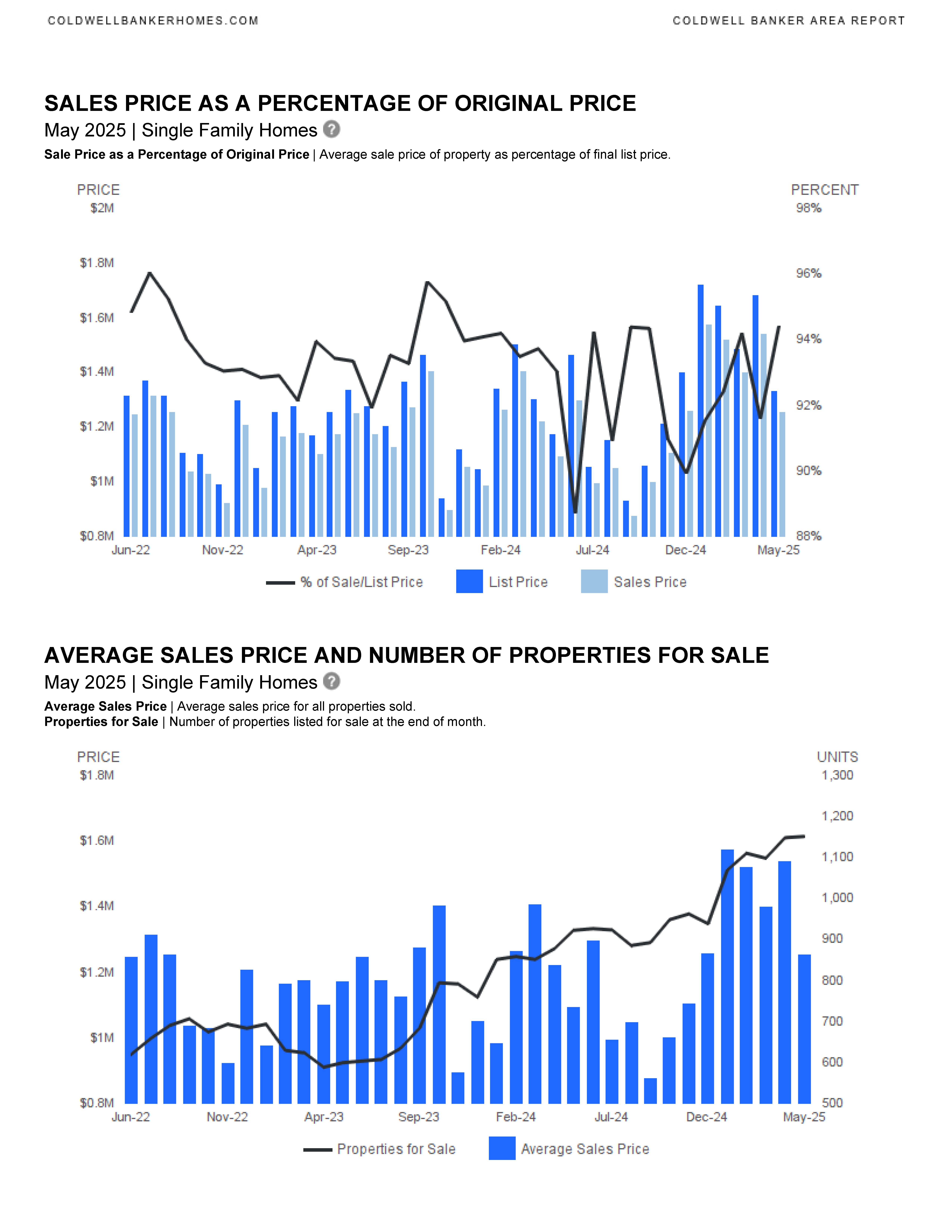
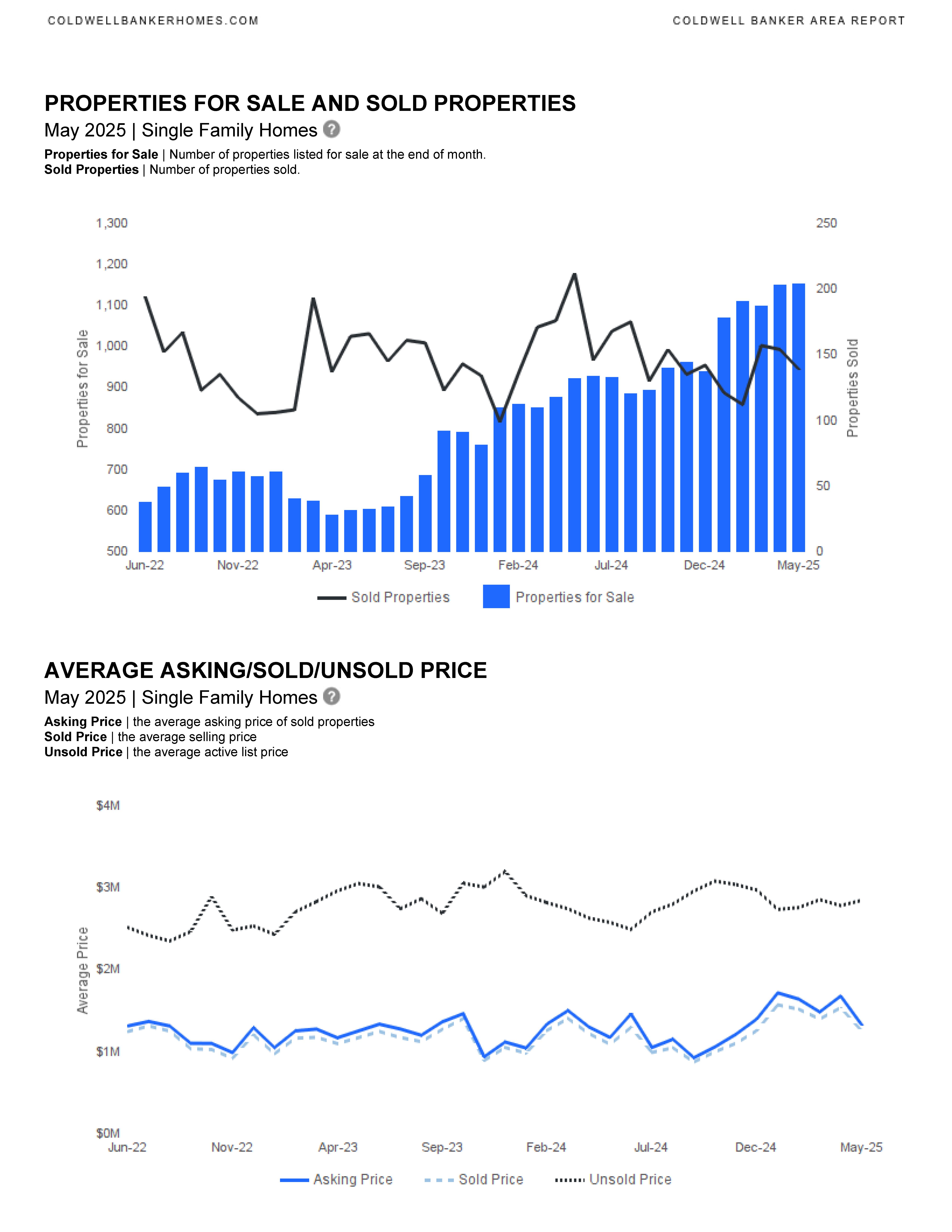
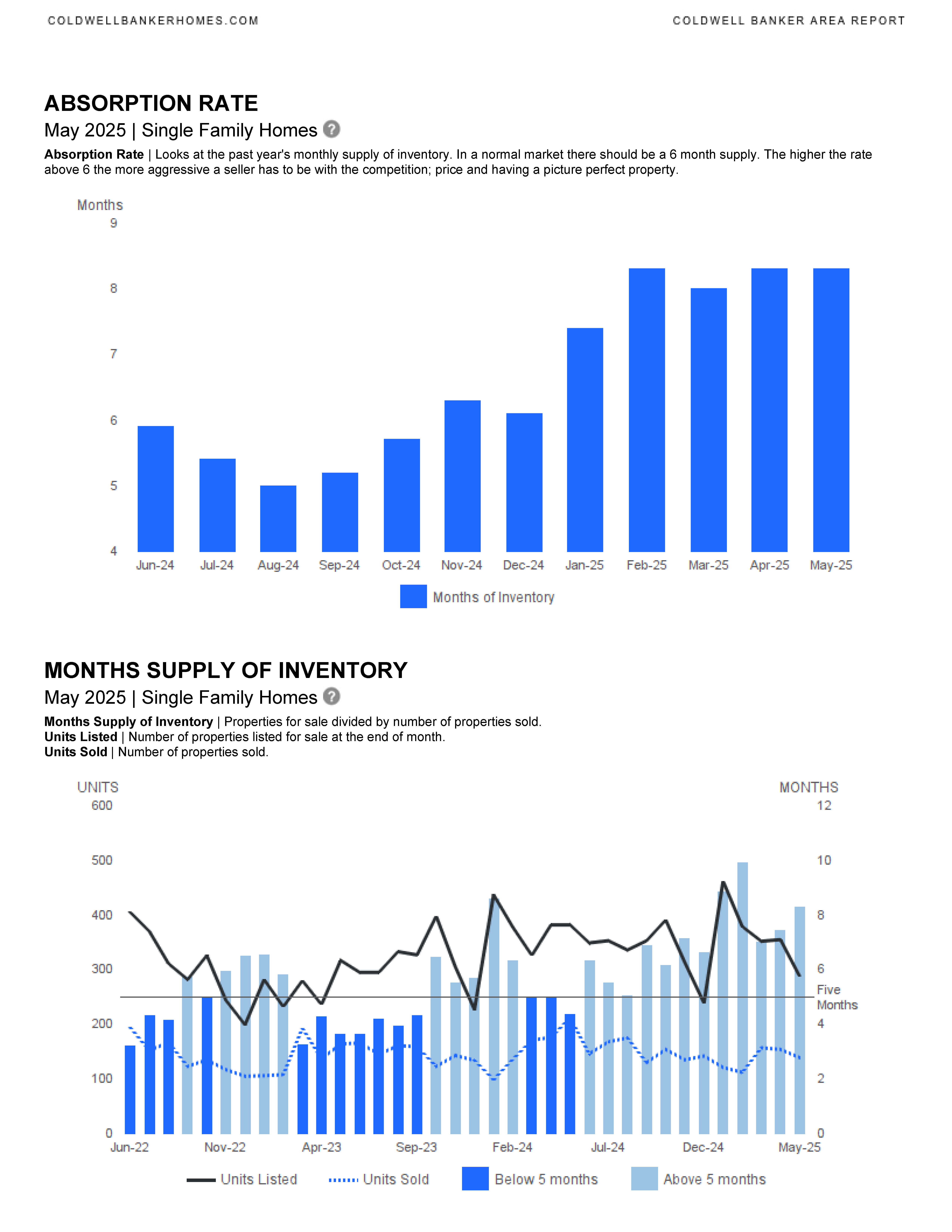
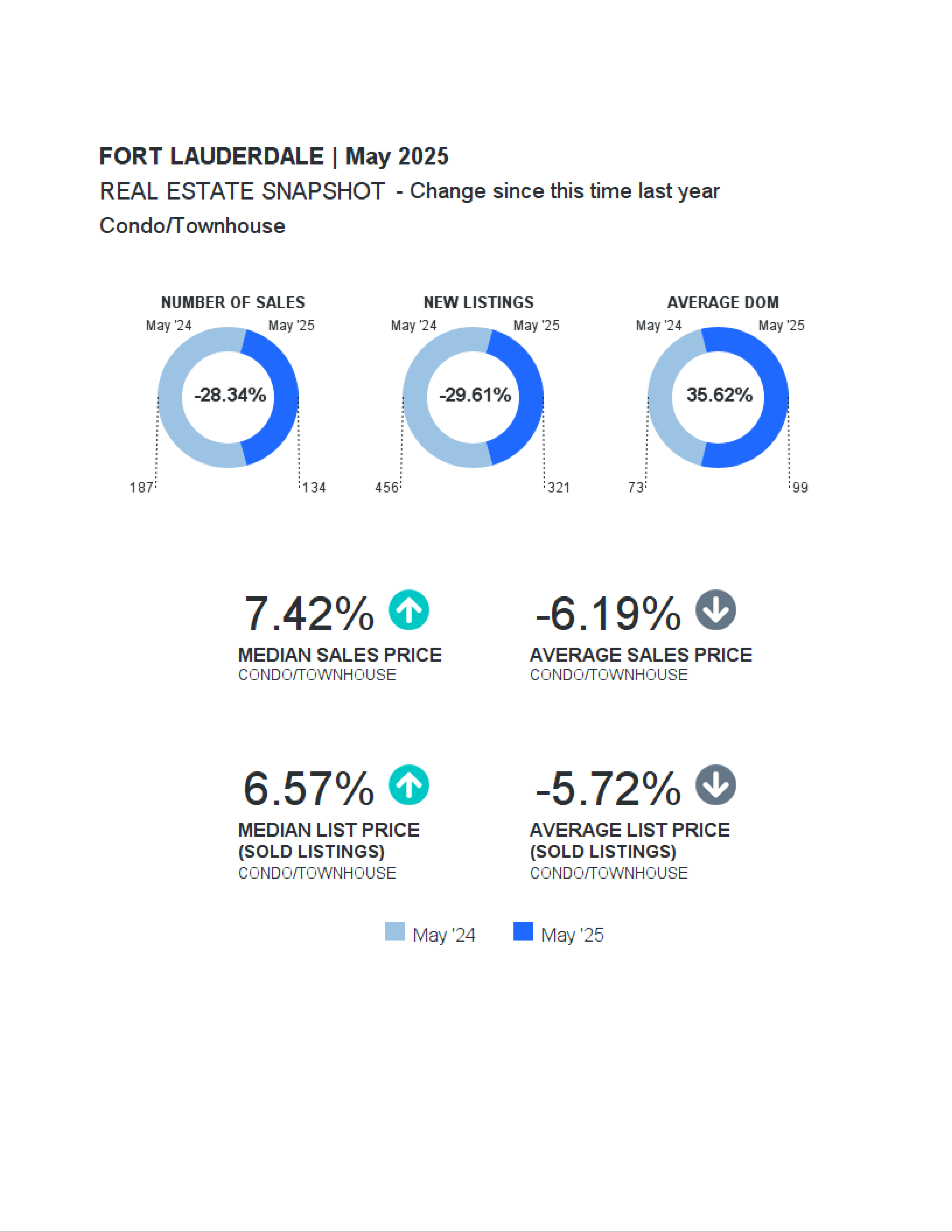
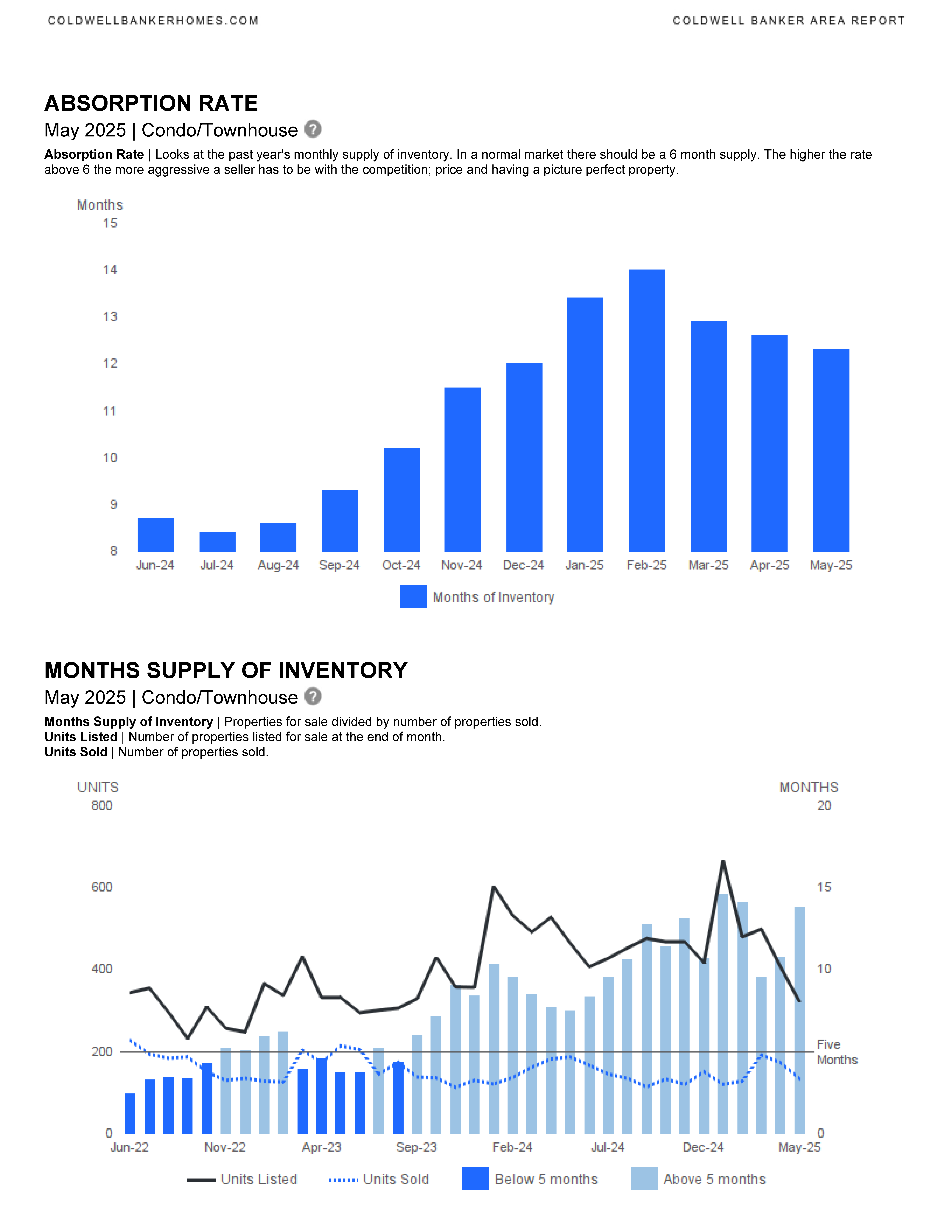

We are entering a new real estate market in SE Florida. This is the time to work with an experienced and knowledgeable real estate professional. Please contact me if you would like to be sent updated market reports for Fort Lauderdale, or another SE Florida city. We can discuss the market, current trends and how we can work together to accomplish your real estate goals. I am here to help.
CONTACT ANNETTE
Let’s start working together!
Annette Dammeyer, REALTOR®, ABR®, AHWD®
Coldwell Banker Realty
901 E Las Olas Blvd STE 101, Fort Lauderdale, FL 33301
808.747.3686
SL 3535792
SE Florida Market Snapshot – May 2025
Market Trends in SE Florida
The real estate market is adjusting. The most obvious trends are fewer number of properties sold and the increase in months of supply of inventory, leaning towards a “buyer’s market”. Seller’s are now reassessing their asking price on their properties for sale. This is a great time to consider a decrease in asking price if the property has been on the market without active offers. I welcome any discussions you may want to have regarding your neighborhood or some of the headlines that have affected the real estate market. Please reach out to chat, even if you are not ready to buy or sell, but just would like to discuss current trends and updates. Here are the Market Snapshots reflecting the last month (compared to the same month last year) for the following areas:
- Fort Lauderdale
- Wilton Manors
- Hollywood
- Dania Beach
- Hallandale Beach
These take into account all property types (Single Family Homes/Condos/Townhomes).
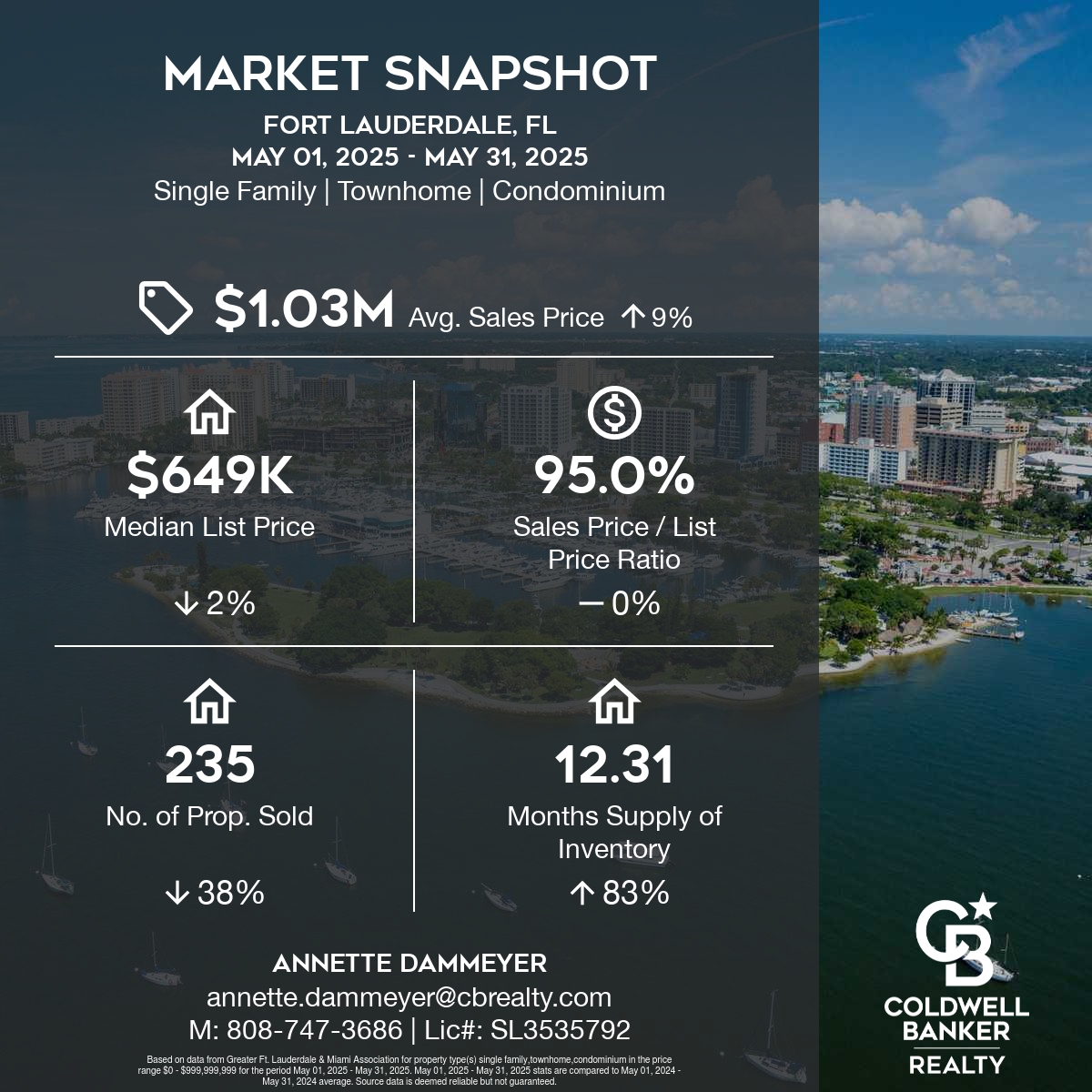
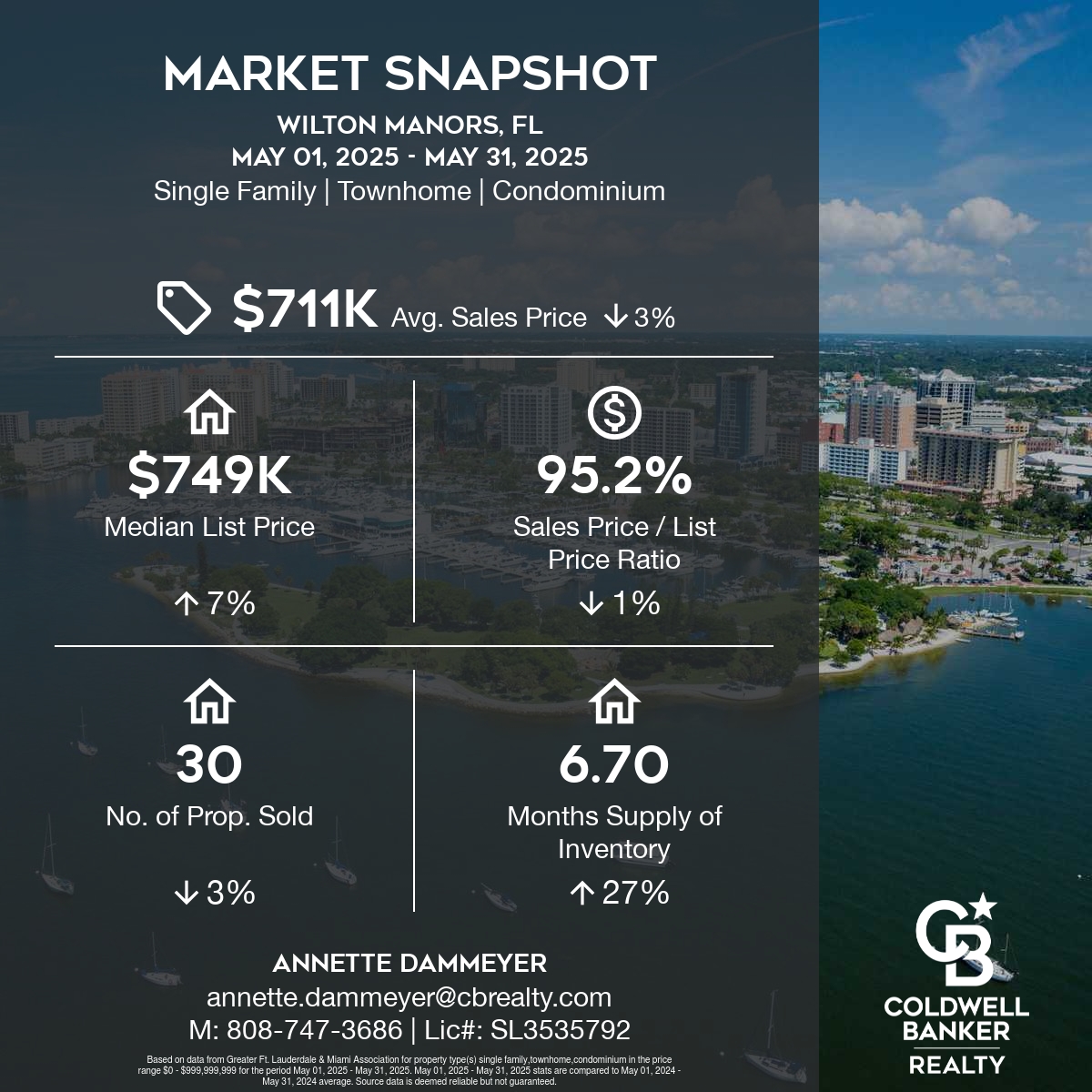
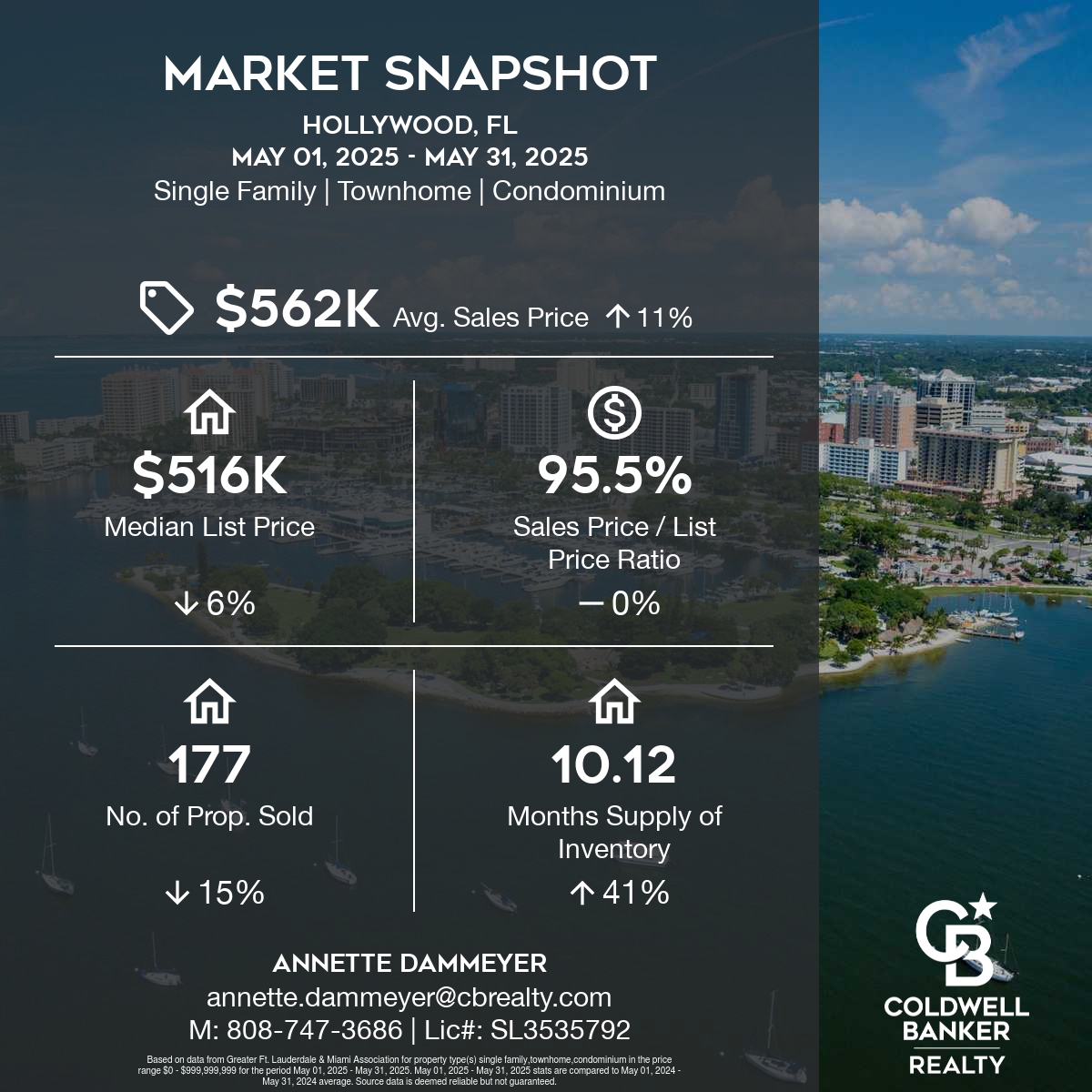
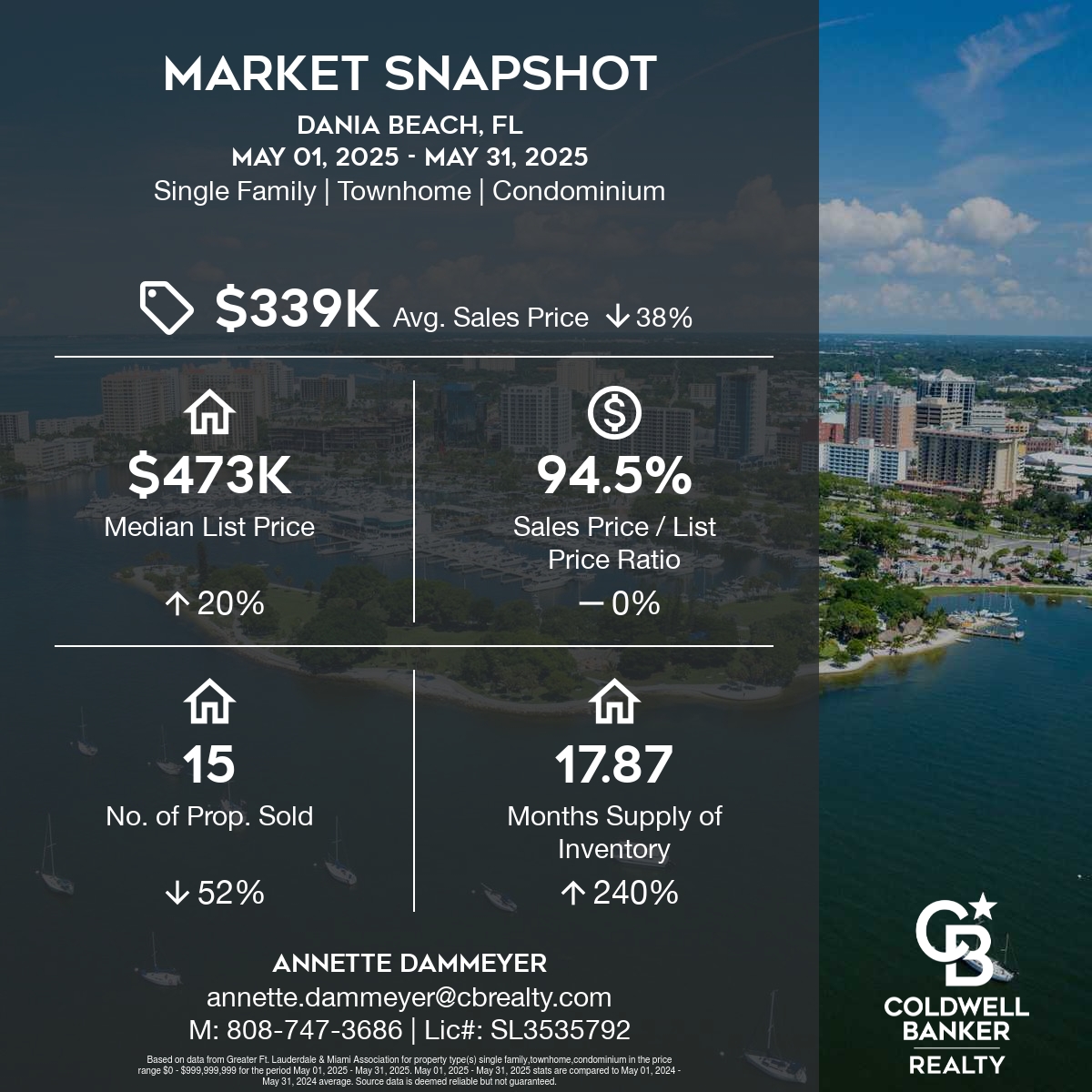
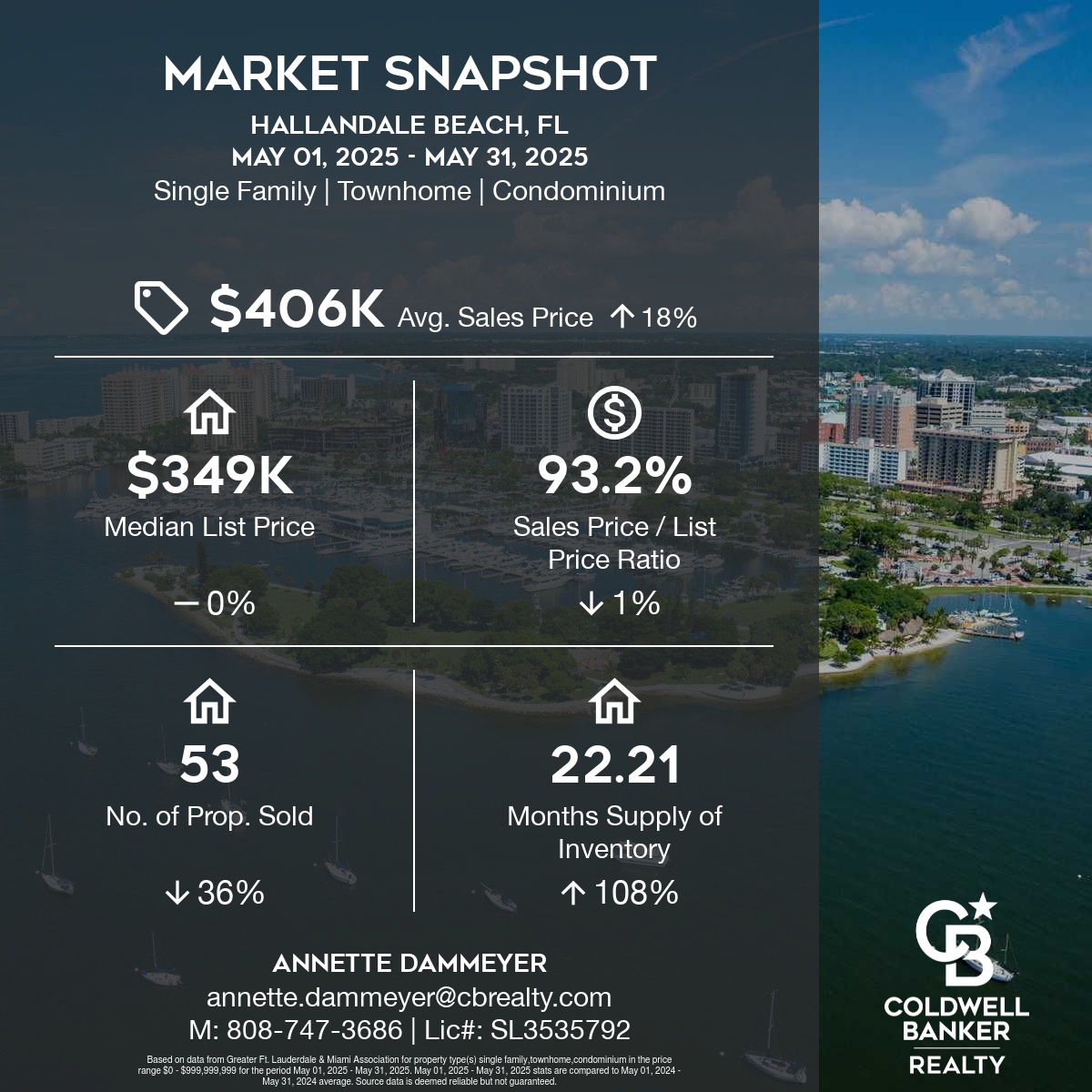
With the rapidly changing real estate market, now is the time to make informed decisions. Contact me today to discuss the current market trends and how we can work together to accomplish your real estate goals. Please call or email me if you would like to be automatically sent detailed market reports for Fort Lauderdale, another SE Florida city, or your specific neighborhood. I am here to help.
CONTACT ANNETTE
Let’s start working together!
Annette Dammeyer, REALTOR®, ABR®, AHWD®
Coldwell Banker Realty
901 E Las Olas Blvd STE 101, Fort Lauderdale, FL 33301
808.747.3686
SL 3535792
Florida Homebuyers: What You Need to Know About Closing Costs Before You Buy

Breaking Down Closing Costs: What Buyers in Southeast Florida Need to Know
Buying a home in Southeast Florida is an exciting journey, but the financial side—especially closing costs—can catch some buyers off guard. Understanding all possible and hidden fees ensures that you’re fully prepared when it’s time to sign the dotted line.
What Are Closing Costs?
Closing costs are the expenses and fees paid at the final stage of the home-buying process—usually ranging from 2% to 5% of the home’s purchase price. While buyers focus on securing a mortgage, it’s crucial to budget for these additional costs to avoid surprises.
Standard Closing Costs for Buyers
1. Loan-Related Fees
- Loan Origination Fee: Lenders charge this fee (typically 0.5%–1% of the loan amount) for processing and underwriting the mortgage.
- Discount Points: Buyers can pay points upfront to lower their interest rate over time.
- Application Fee: Some lenders charge an application fee to cover administrative costs.
2. Property-Related Fees
- Appraisal Fee: Before approving a loan, lenders require an appraisal, usually costing $300–$600.
- Home Inspection Fee: While not mandatory, inspections are essential and can cost $300–$500.
- Survey Fee: In Southeast Florida, certain properties may require a land survey, ranging from $350–$700.
3. Title and Legal Fees
- Title Search and Title Insurance: Protecting against ownership disputes, title search fees range from $200–$400, while title insurance can cost around 0.5% of the home’s price.
- Attorney Fees: While Florida doesn’t mandate attorneys for closings, hiring one for review may cost between $500–$2,000.
- Recording Fees: Florida counties charge a fee (usually around $50–$100) to officially record the deed and mortgage documents.
4. Prepaid Expenses
- Homeowners Insurance: Southeast Florida homes often require comprehensive insurance, paid upfront for the first year ($1,000–$3,000).
- Property Taxes: Buyers often need to prepay property taxes, which vary based on location and home value.
- Escrow Fees: Lenders may require several months’ worth of taxes and insurance payments held in escrow.
5. Buyer’s Agent Commission
As of July 2024, Florida requires buyers to sign a Buyer Broker Agreement before working with a real estate agent. This contract outlines the agent’s responsibilities and how their commission will be paid. Buyers can negotiate this fee with their agent, and in some cases, request that the seller covers it as part of the purchase contract.
How Buyer’s Agent Commissions Work Now
Traditionally, the seller covered the commission for both their agent and the buyer’s agent. However, under the new rules:
- Buyers must negotiate and agree on their agent’s commission upfront.
- The commission may be paid directly by the buyer or negotiated as part of the purchase offer.
- Sellers are no longer required to offer compensation to the buyer’s agent through MLS listings.
Hidden or Unexpected Fees Buyers Should Know
While the costs above are standard, buyers should also prepare for hidden fees that can add up quickly.
- HOA Transfer Fee: If the home is in a community with a homeowners association, expect transfer fees between $200–$500.
- Pest Inspection: In Florida’s humid climate, termite inspections are often required (~$100–$300).
- Flood Zone Determination Fee: Southeast Florida homes may fall within flood-prone areas, requiring an additional assessment fee (~$50–$150).
- Wire Transfer Fees: Sending funds for closing may incur bank fees (~$25–$50 per transaction).
- Courier Fees: If physical document transfers are needed, courier services might charge $30–$100.
How Buyers Can Reduce Closing Costs
- Negotiate with the Seller: In a buyer’s market, sellers may agree to cover certain fees.
- Shop for Lenders: Different lenders have varying origination and application fees.
- Check for First-Time Buyer Assistance: Florida offers programs that help cover closing costs for eligible buyers.
Understanding and preparing for closing costs is essential to avoid surprises and ensure a smooth homebuying experience in SE Florida. When you know what to expect, you can budget more effectively and move into your new home with confidence.
If you’re planning to buy a home in SE Florida and want expert guidance every step of the way, I’m here to help you navigate the process from start to finish—transparently and stress-free.
CONTACT ANNETTE
Let’s start working together!
Annette Dammeyer, REALTOR®, ABR®, AHWD®
Coldwell Banker Realty
901 E Las Olas Blvd STE 101, Fort Lauderdale, FL 33301
808.747.3686
SL 3535792
Fort Lauderdale April 2025 Area Report
Fort Lauderdale April 2025 real estate statistics have been released.
Fort Lauderdale Area Reports
Single Family Homes
Condominium & Townhouses
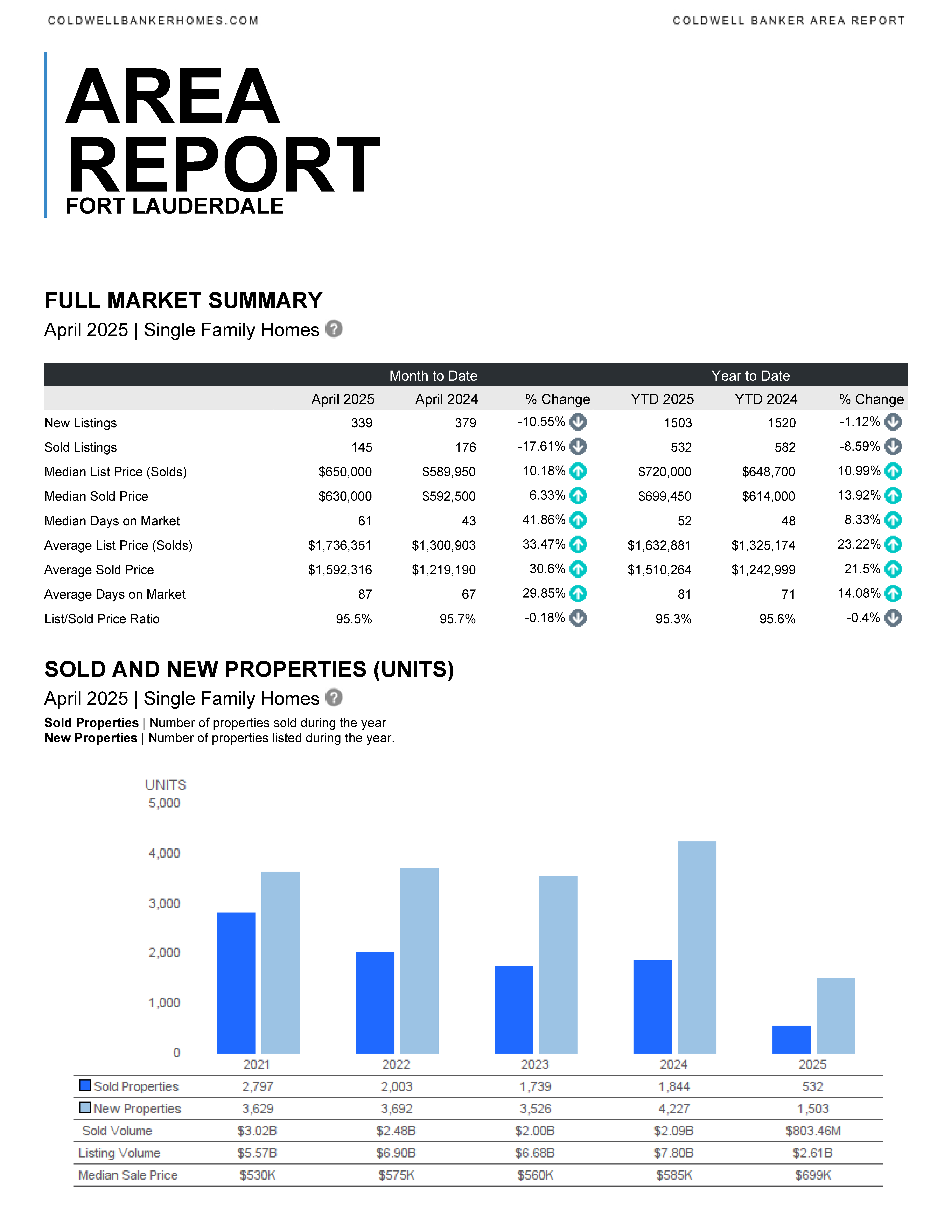
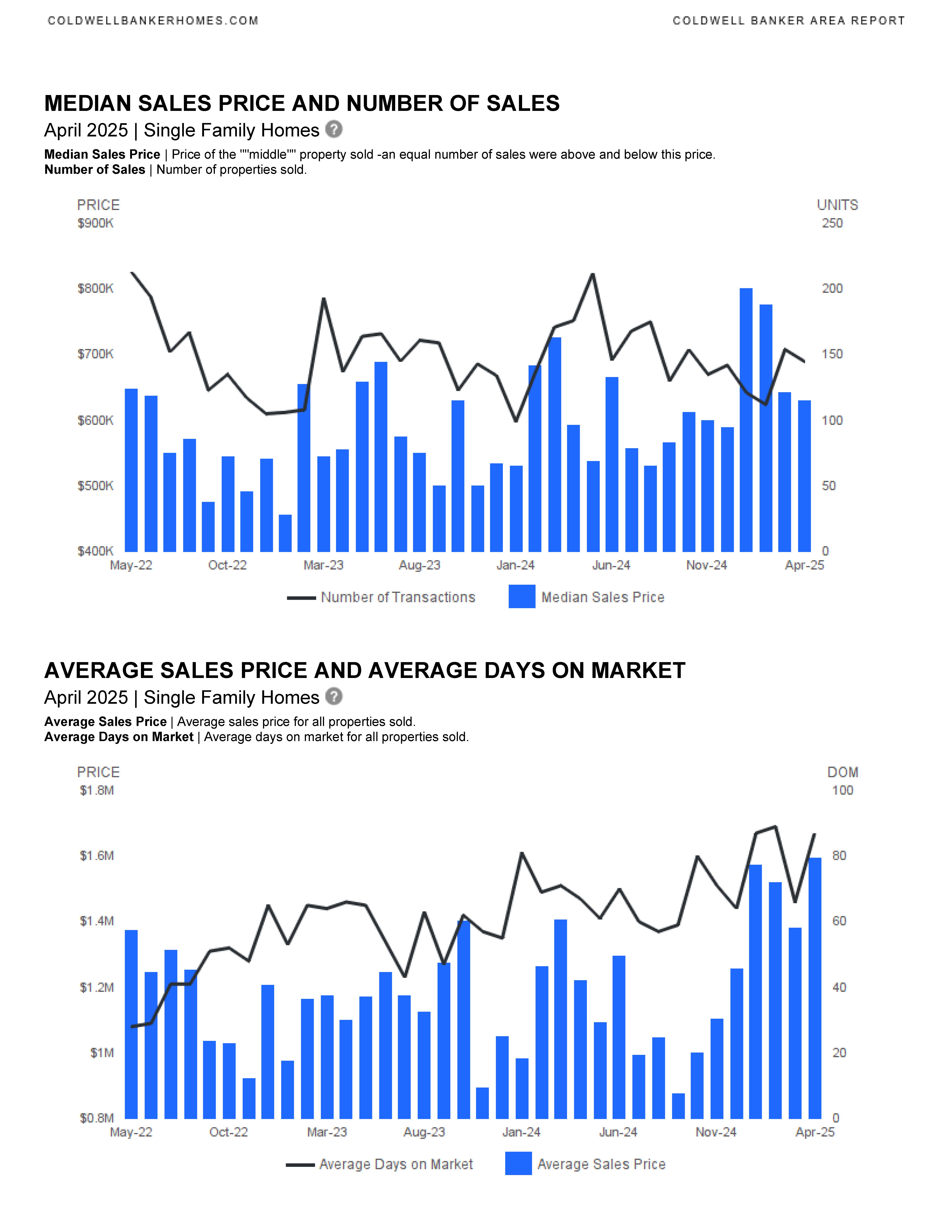
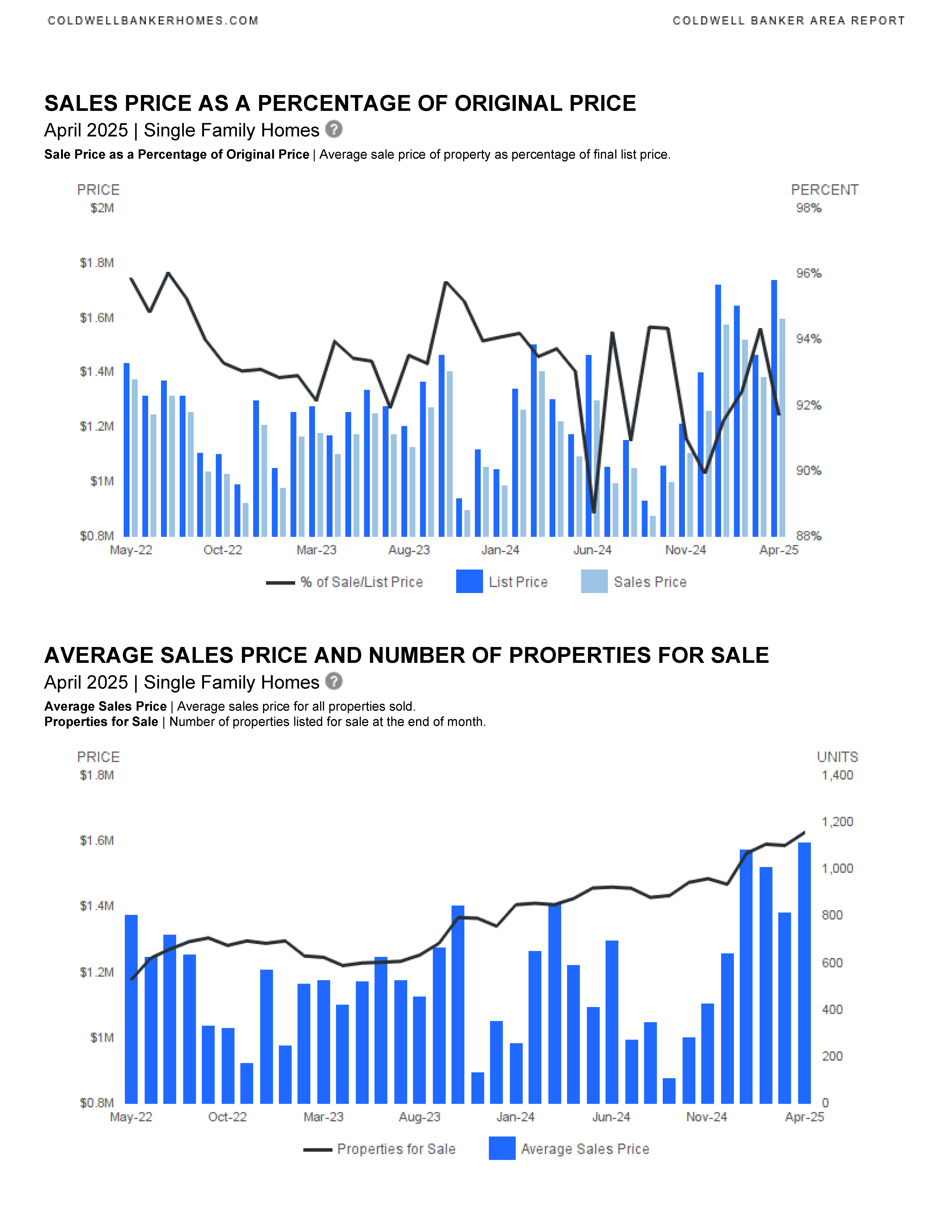
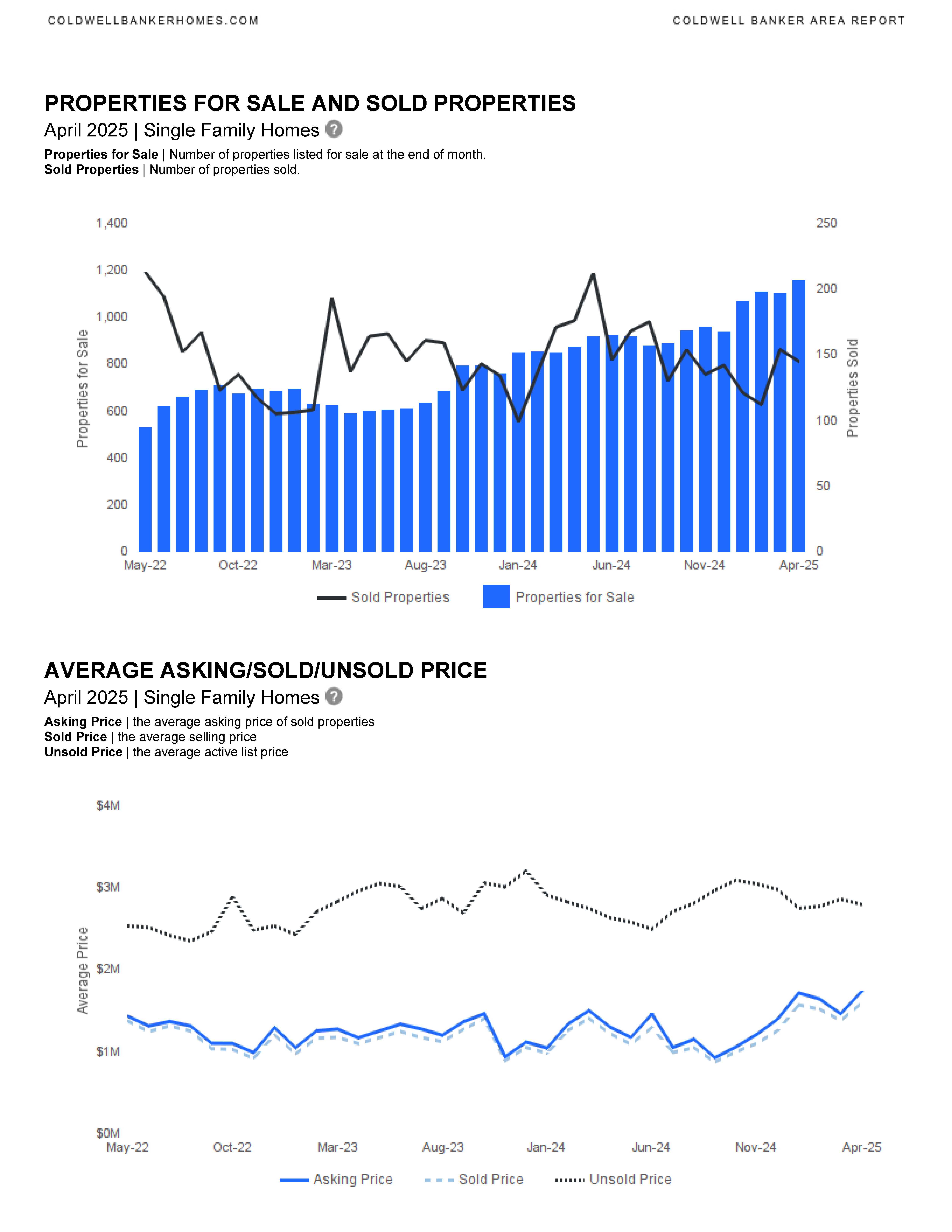
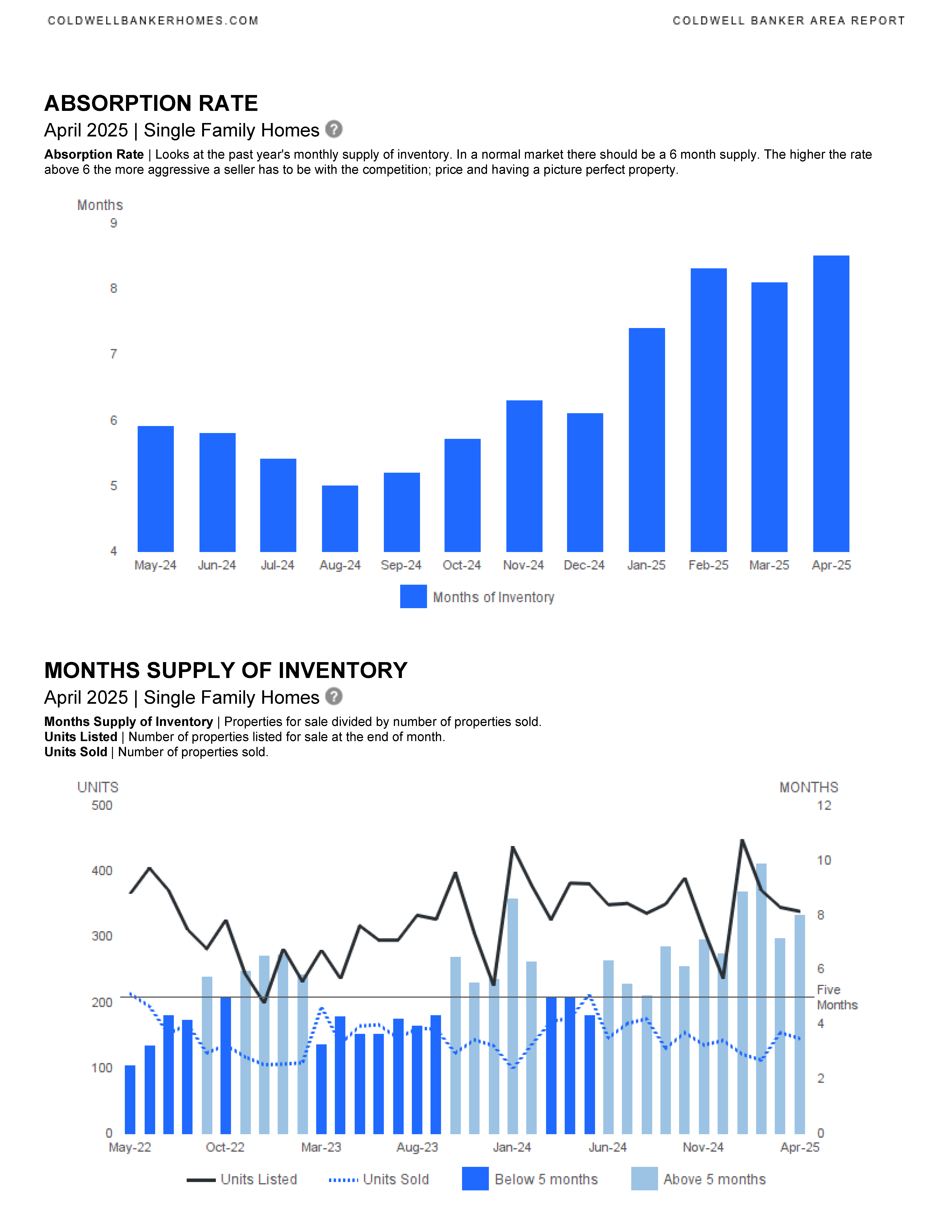
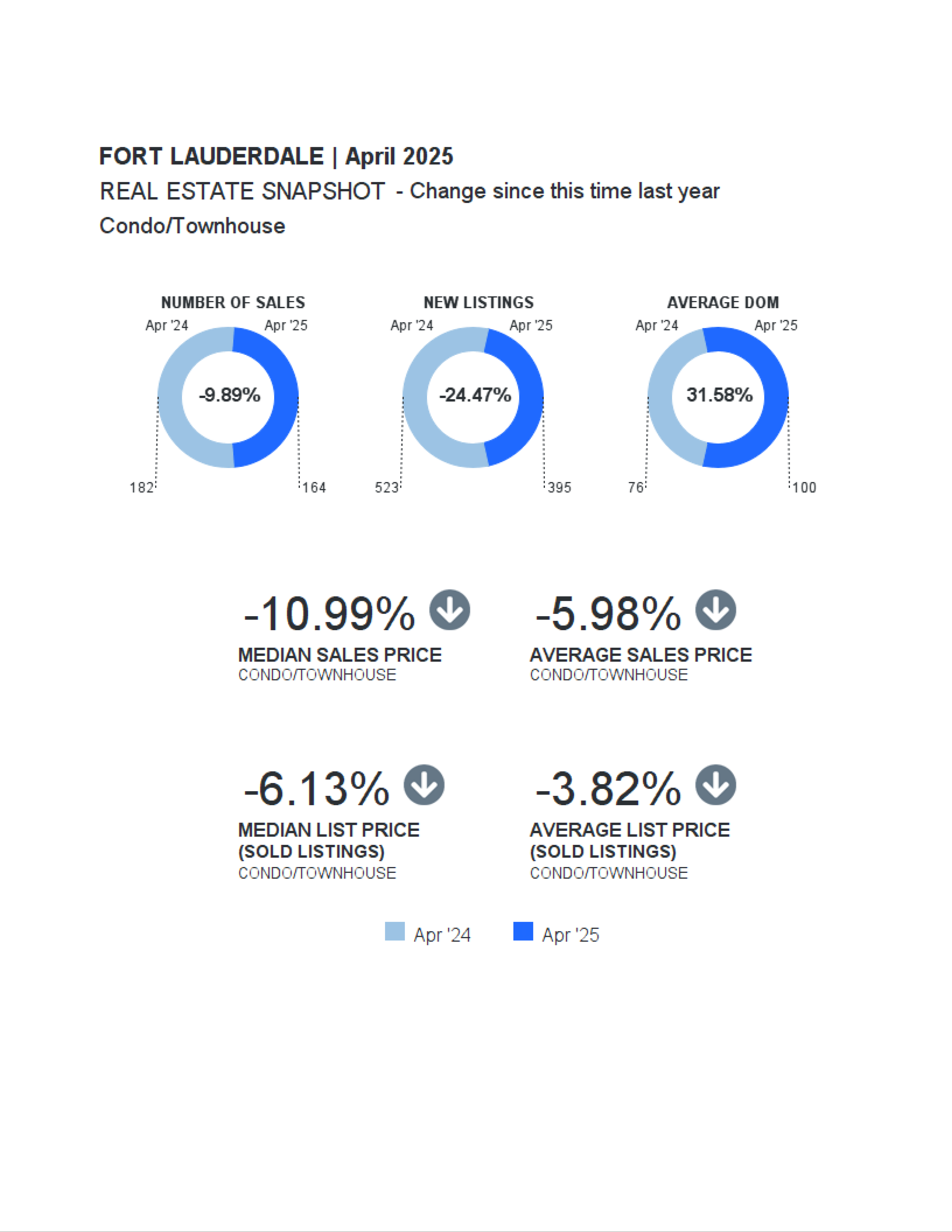
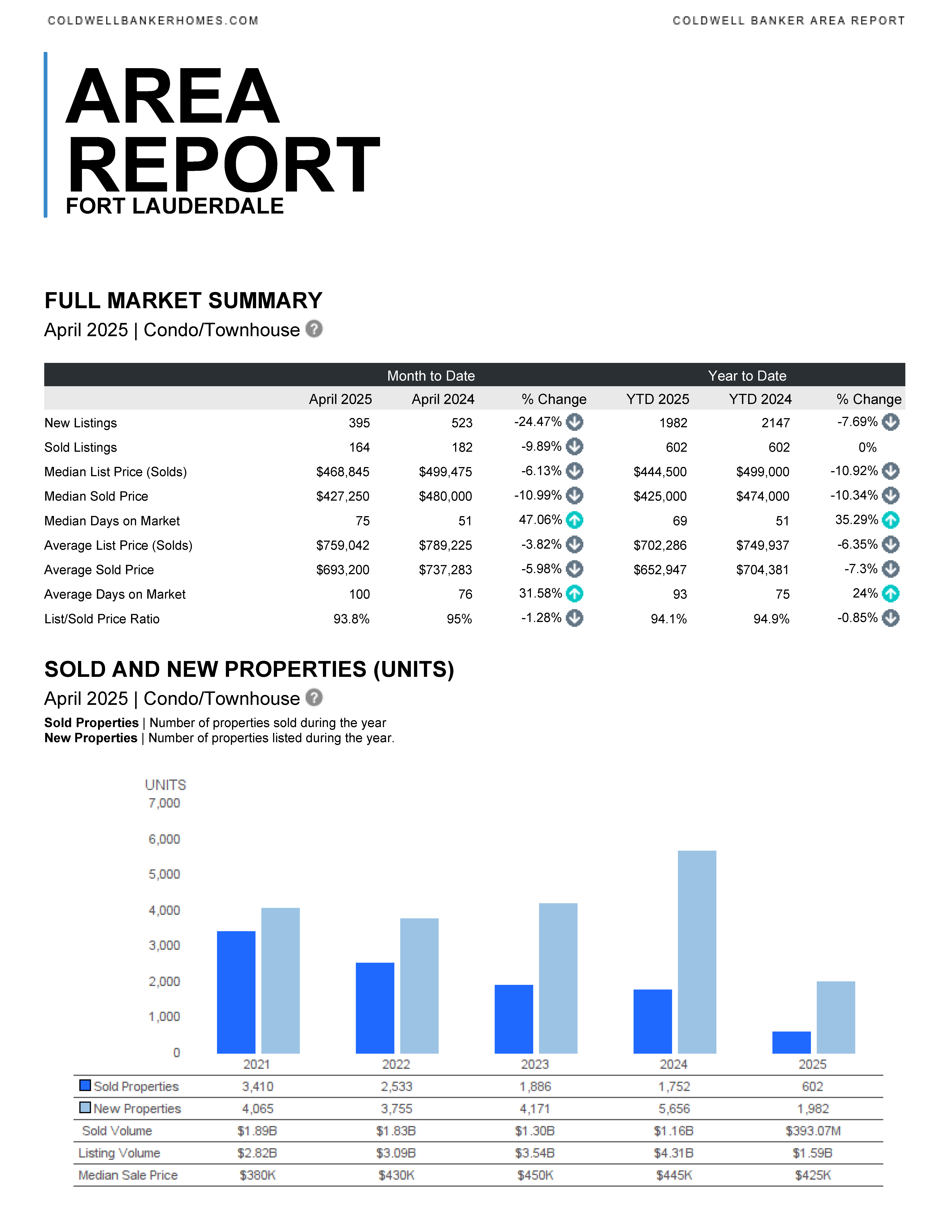
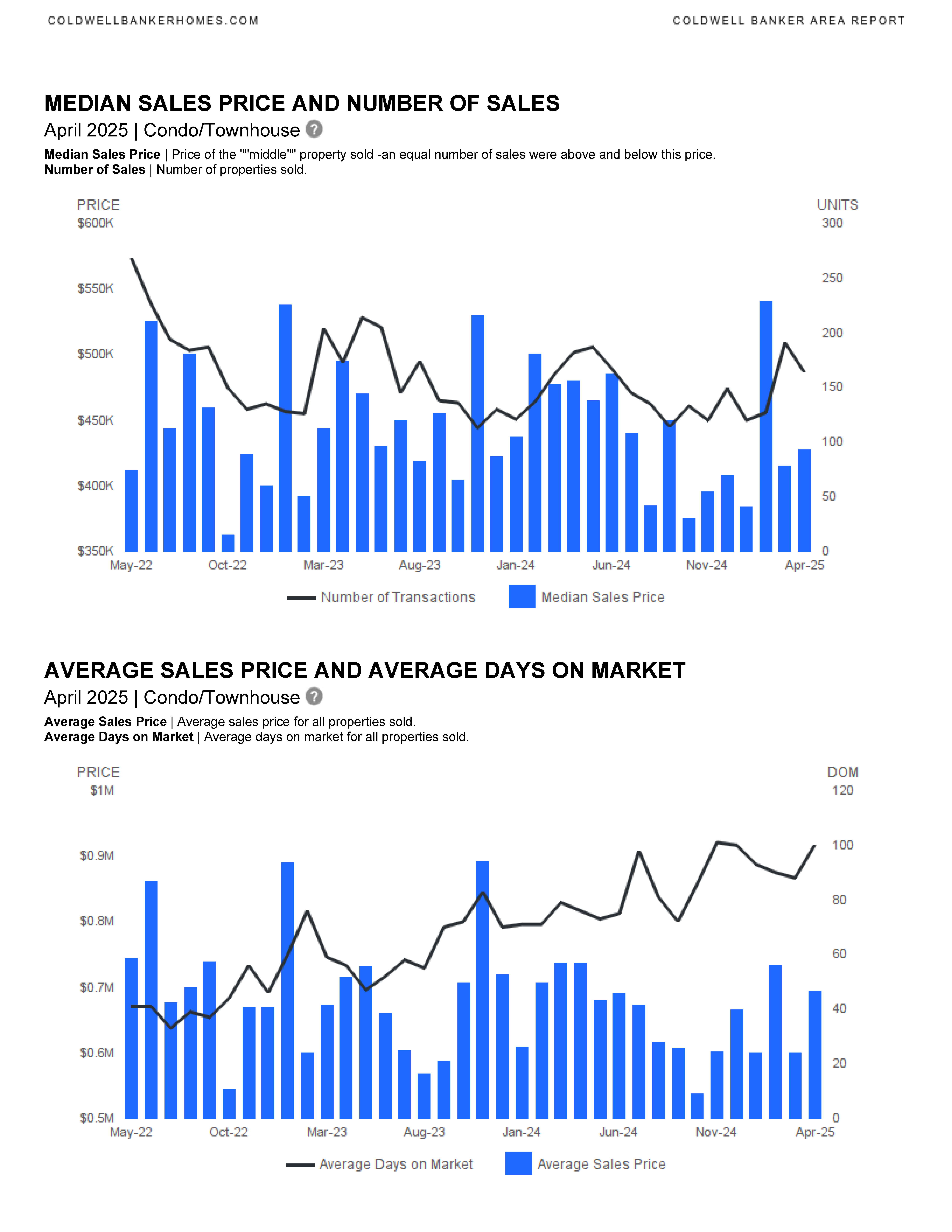
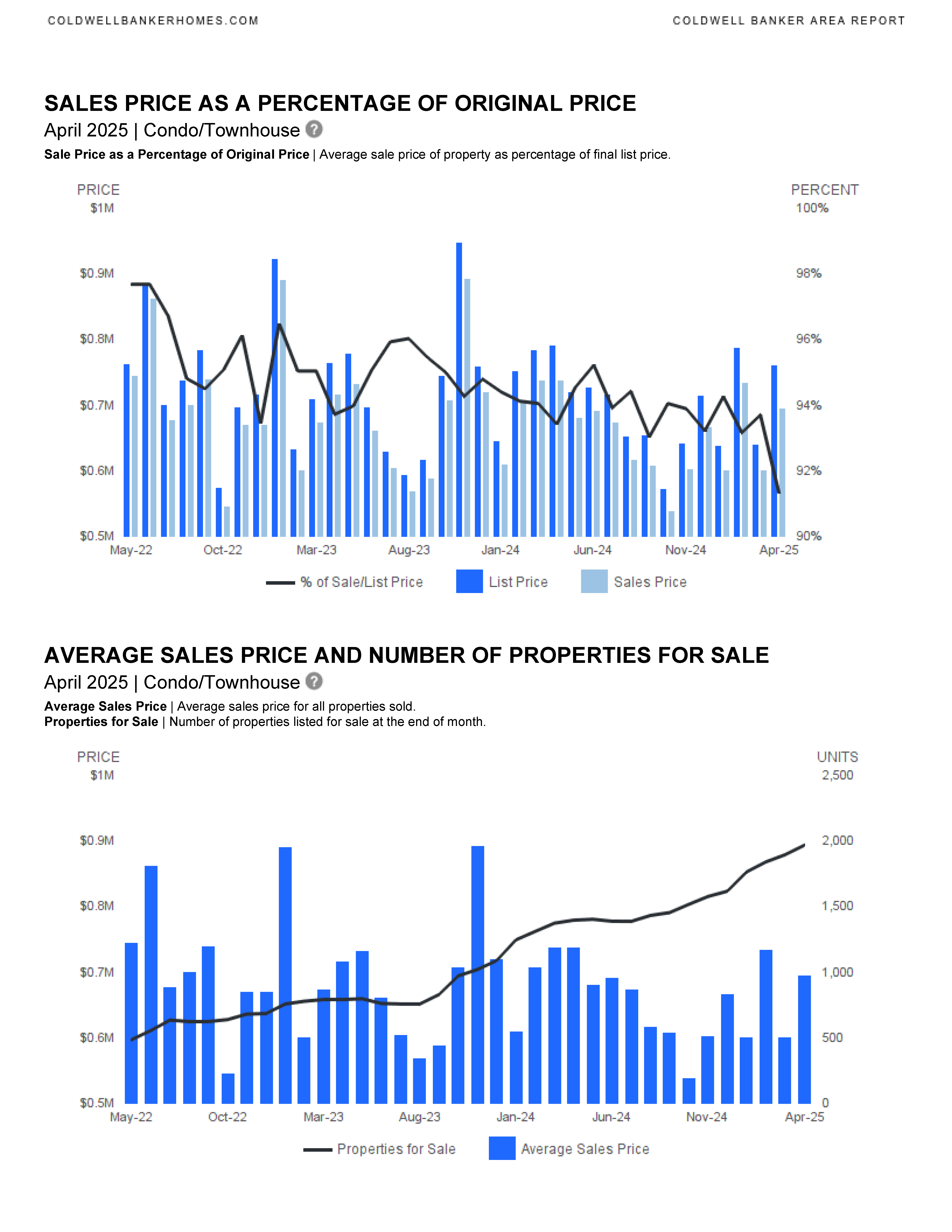
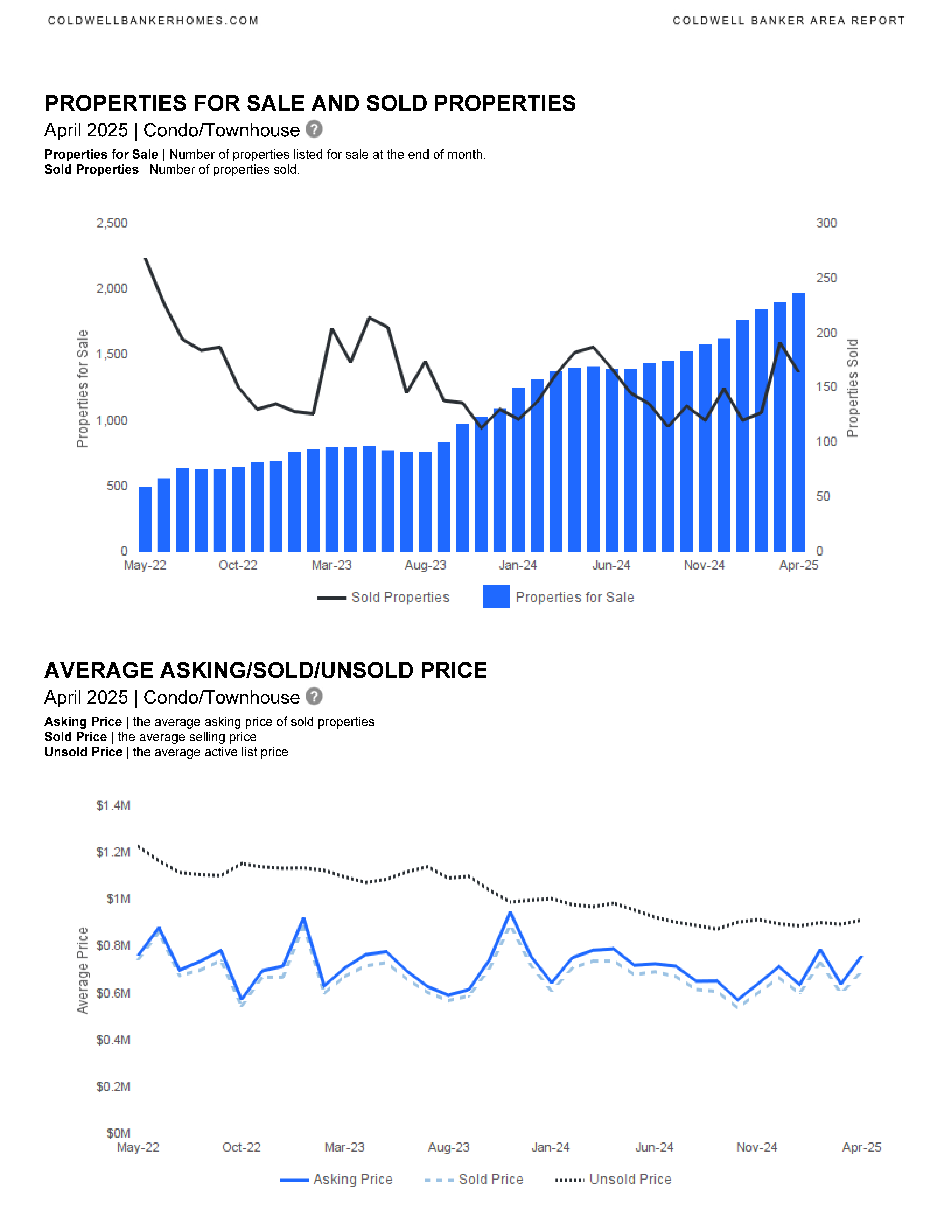
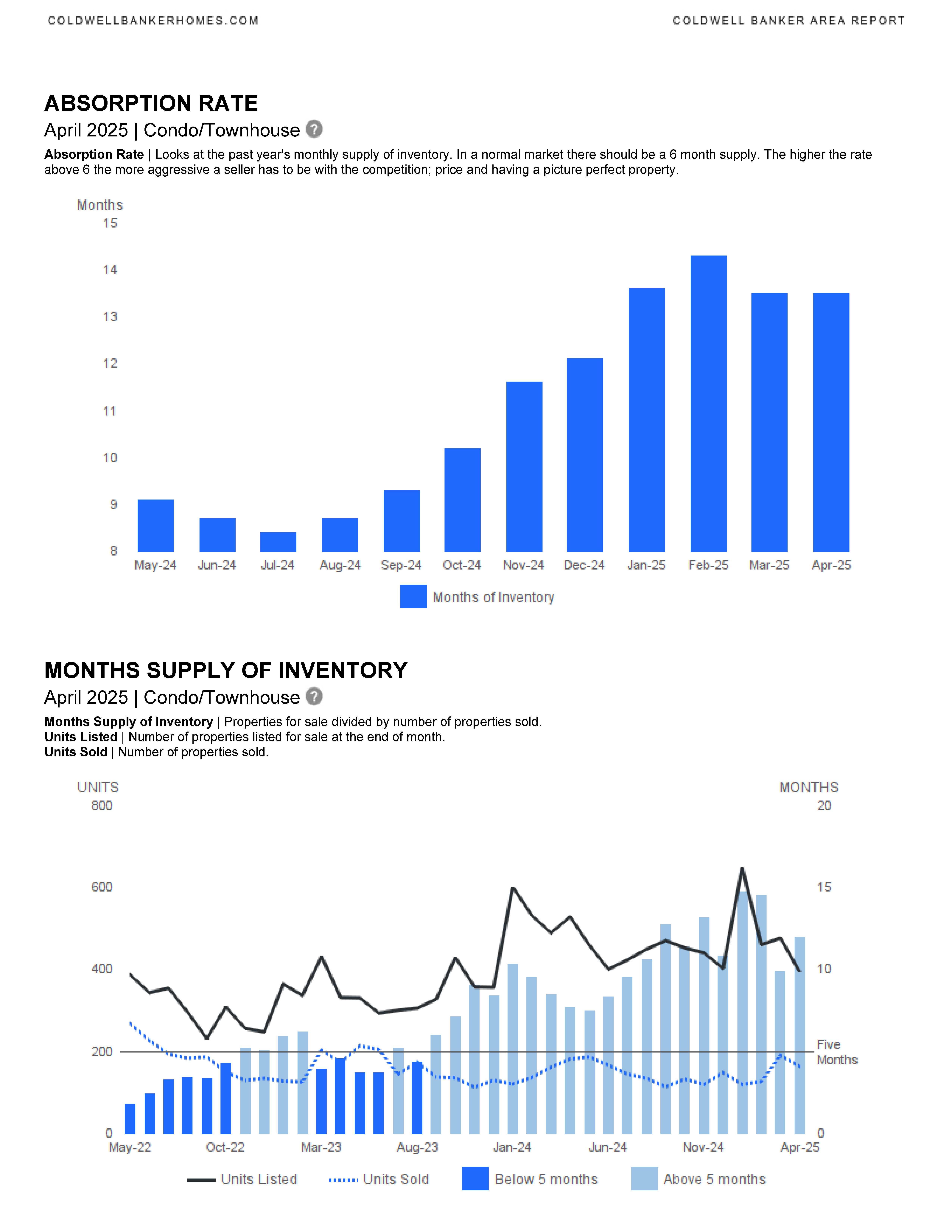
This is the April 2025 Area Report providing a detailed analysis of residential real estate market trends in Fort Lauderdale. It includes data for single-family homes and condos/townhouses, comparing April 2025 to April 2024 and year-to-date statistics.
Key Highlights
Single-Family Homes:
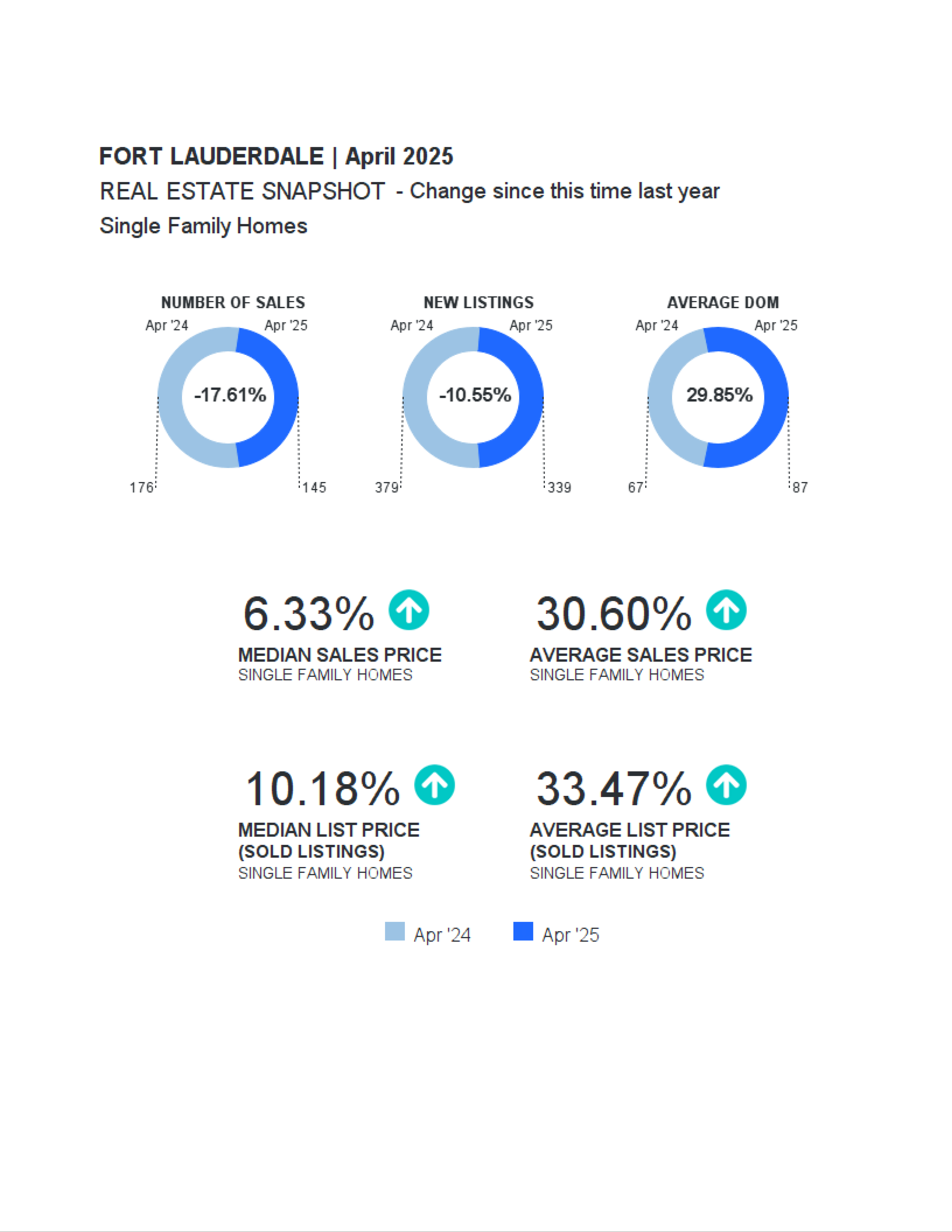
• New Listings: Down 10.55% month-to-date and 1.12% year-to-date.
• Sold Listings: Decreased by 17.61% month-to-date and 8.59% year-to-date.
• Median Sold Price: Increased by 6.33% month-to-date and 13.92% year-to-date.
• Average Sold Price: Up 30.6% month-to-date and 21.5% year-to-date.
• Median Days on Market: Increased by 41.86% month-to-date and 8.33% year-to-date.
• List/Sold Price Ratio: Slight decrease (-0.18% month-to-date, -0.4% year-to-date).
Condos/Townhouses:
• New Listings: Down 24.47% month-to-date and 7.69% year-to-date.
• Sold Listings: Decreased by 9.89% month-to-date but remained flat year-to-date.
• Median Sold Price: Declined by 10.99% month-to-date and 10.34% year-to-date.
• Average Sold Price: Down 5.98% month-to-date and 7.3% year-to-date.
• Median Days on Market: Increased by 47.06% month-to-date and 35.29% year-to-date.
• List/Sold Price Ratio: Slight decrease (-1.28% month-to-date, -0.85% year-to-date).
Commonly asked questions while reviewing the reports:
What is the difference between “Median Sales Price” and “Average Sales Price”?
Median Sales Price | Price of the “”middle”” property sold -an equal number of sales were above and below this price.
Average Sales Price | Average sales price for all properties sold.
What does “Absorption Rate” mean?
Absorption Rate | Looks at the past year’s monthly supply of inventory. In a normal market there should be a 6 month supply. The higher the rate above 6 the more aggressive a seller has to be with the competition; price and having a picture perfect property.
Single Family Home Area Report listed first, Condo/Townhouses listed second:

We are entering a new real estate market in SE Florida. This is the time to work with an experienced and knowledgeable real estate professional. Please contact me if you would like to be sent updated market reports for Fort Lauderdale, or another SE Florida city. We can discuss the market, current trends and how we can work together to accomplish your real estate goals. I am here to help.
CONTACT ANNETTE
Let’s start working together!
Annette Dammeyer, REALTOR®, ABR®, AHWD®
Coldwell Banker Realty
901 E Las Olas Blvd STE 101, Fort Lauderdale, FL 33301
808.747.3686
SL 3535792
How to Avoid Going Over Budget in Your Home Renovation
YOUR HOME RENOVATION
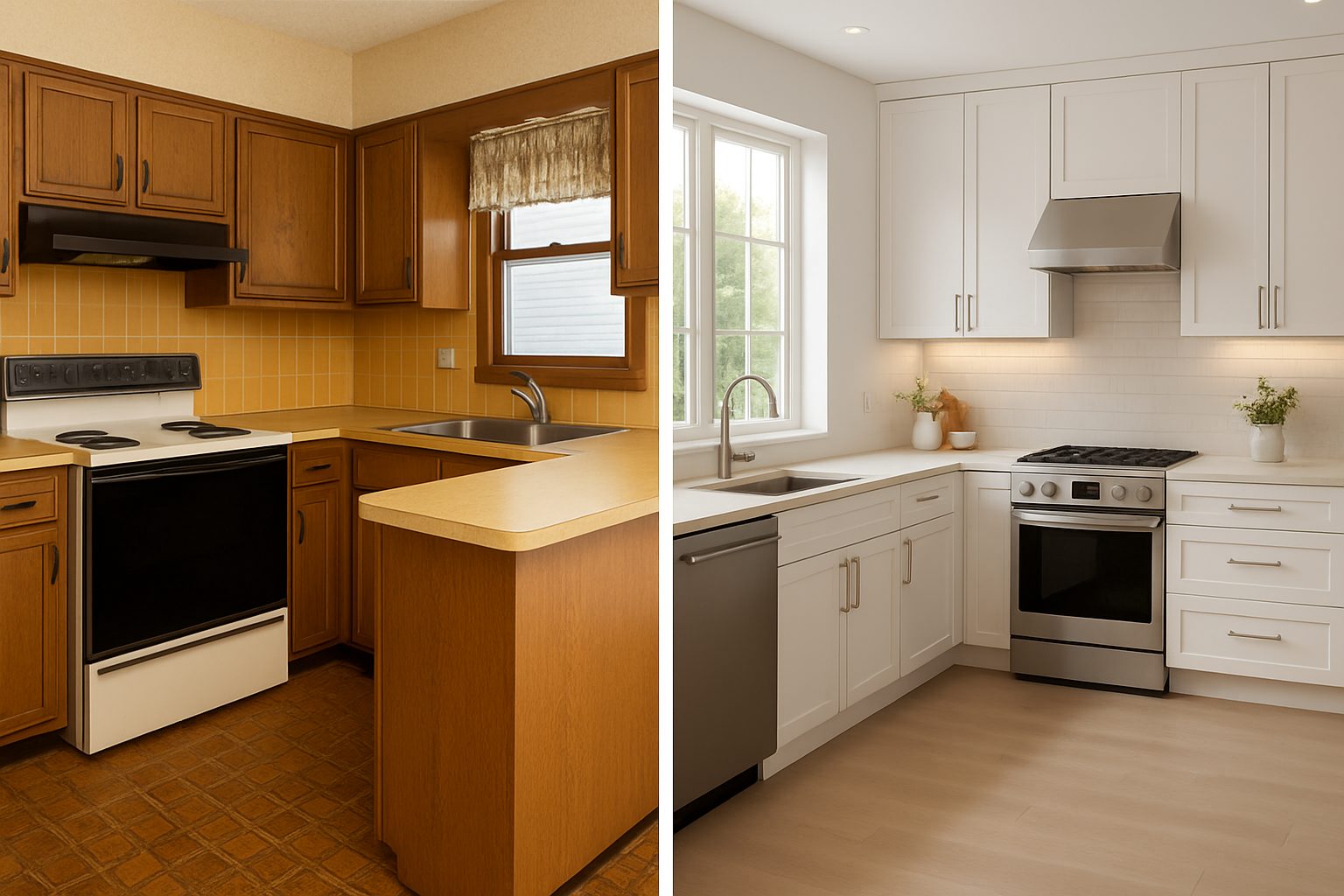
You are renovating your home? How exciting! Now is the time to carefully plan, research and create your budget. The high-impact home upgrades can deliver a substantial ROI (Return on Investment) – as long as you carefully manage the cost. ROI is calculated by dividing the net income from an investment by the original cost of the investment.
How to Avoid Going Over Budget in Your Home Renovation
Lessons from Homeowners Who Learned the Hard Way
Renovating a home can be exciting, but it’s easy for costs to spiral out of control if you’re not careful. As a real estate professional, I’ve seen firsthand how simple mistakes can lead to expensive surprises. Here’s how to stay on budget while still achieving the renovation results you want—plus real examples of costly mistakes homeowners have made.
1. Set a Realistic Budget—Then Add a Buffer
Many homeowners set their renovation budget based on best-case scenarios. The reality? Unexpected costs WILL pop up. Whether it’s hidden plumbing issues or delays in material deliveries, adding a 10–20% contingency fund to your budget can save you from financial headaches.
❌ Costly Mistake Example: A homeowner planned to renovate their kitchen for $25,000 but didn’t account for hidden electrical issues behind the walls. After hiring an electrician and bringing everything up to code, they ended up spending an additional $8,000—completely throwing their budget off track.
✅ Smart Move: Get a professional inspection of your home before finalizing your renovation budget. This way, you can anticipate potential structural, electrical, or plumbing surprises.
2. Don’t Over-Customize—Stick to Practical Upgrades
Personalizing your home is great, but going overboard with custom work can drain your budget quickly. Specialty designs, rare materials, and custom-built cabinetry or fixtures can easily cost double what standard options do.
❌ Costly Mistake Example: One homeowner insisted on custom tile work imported from Italy for their bathroom remodel. Between shipping fees, installation costs, and unexpected delays, the final bill exceeded their initial budget by 40%—all for a feature that didn’t significantly increase the home’s value.
✅ Smart Move: Focus on upgrades that balance aesthetics and resale value. Opt for high-quality but readily available materials that give a luxurious look without breaking the bank.
3. Choose the Right Contractor—Not Just the Cheapest
Hiring the lowest-bid contractor might seem like a way to save money, but it can be a costly mistake if the quality of work is poor. Cutting corners on labor can lead to more repairs and reworks down the line.
❌ Costly Mistake Example: A homeowner hired a contractor offering a kitchen remodel at half the price of competitors. Turns out, the contractor failed to get permits, used substandard materials, and left plumbing unsealed—causing leaks and damage weeks later. The homeowner ended up hiring another team to redo everything properly, doubling their initial budget.
✅ Smart Move: Get multiple quotes and check references before hiring a contractor. Look for professionals who are licensed, insured, and experienced in the type of work you need.
4. Avoid Scope Creep—Stick to the Original Plan
Many homeowners start with a simple project, only to get inspired mid-renovation and expand the scope of work. Adding extra features or changing materials mid-way can quickly inflate costs.
❌ Costly Mistake Example: A family planned a minor bathroom refresh but decided last-minute to expand the footprint by knocking down a wall. This required new flooring, plumbing adjustments, and structural reinforcements, turning what was supposed to be a $10,000 update into a $35,000 remodel.
✅ Smart Move: Set clear renovation goals upfront. If you want to make changes mid-project, assess the financial impact before moving forward.
5. Source Materials Wisely—Don’t Rush Purchases
Ordering materials on impulse or relying solely on one supplier can cost more than necessary. Many homeowners fail to shop around for better pricing, bulk deals, or alternative materials.
❌ Costly Mistake Example: A homeowner rushed to order custom countertops just before installation without comparing vendors. Later, they discovered another supplier offering the same quality for 30% less, but it was too late to cancel the original order.
✅ Smart Move: Research multiple suppliers before purchasing materials. Check for discounts, bulk deals, and seasonal promotions. Also, consider remnant sales for countertops, flooring, and other materials.
6. The Pitfalls of DIY Renovations—Know Your Limits
DIY renovations can be rewarding, but they can also lead to unexpected costs and complications if you lack the necessary skills or experience. While painting a room or updating fixtures may be manageable, major renovations require professional expertise.
❌ Costly Mistake Example: A homeowner attempted to install new flooring without professional help, mismeasuring materials and failing to level the subfloor properly. As a result, boards began warping and separating within months, requiring a full replacement—adding thousands to the overall budget.
✅ Smart Move: Be honest about your skill level and know when to hire a pro. Electrical work, plumbing updates, and structural changes should always be handled by licensed professionals to avoid safety risks and future repairs.
Home renovations don’t have to drain your savings. The key is to plan ahead, expect the unexpected, and make informed decisions along the way. By learning from common budgeting mistakes, you can ensure your renovation stays on track—without financial regrets.
If you are renovating in preparation to sell, I can introduce you to another way to control your upfront cost through RealVitalize®, our program that provides home sellers with home improvement resources during the listing period, with no upfront costs or interest fees. Reach out today, I am here to help.
CONTACT ANNETTE
Let’s start working together!
Annette Dammeyer, REALTOR®, ABR®, AHWD®
Coldwell Banker Realty
901 E Las Olas Blvd STE 101, Fort Lauderdale, FL 33301
808.747.3686
SL 3535792
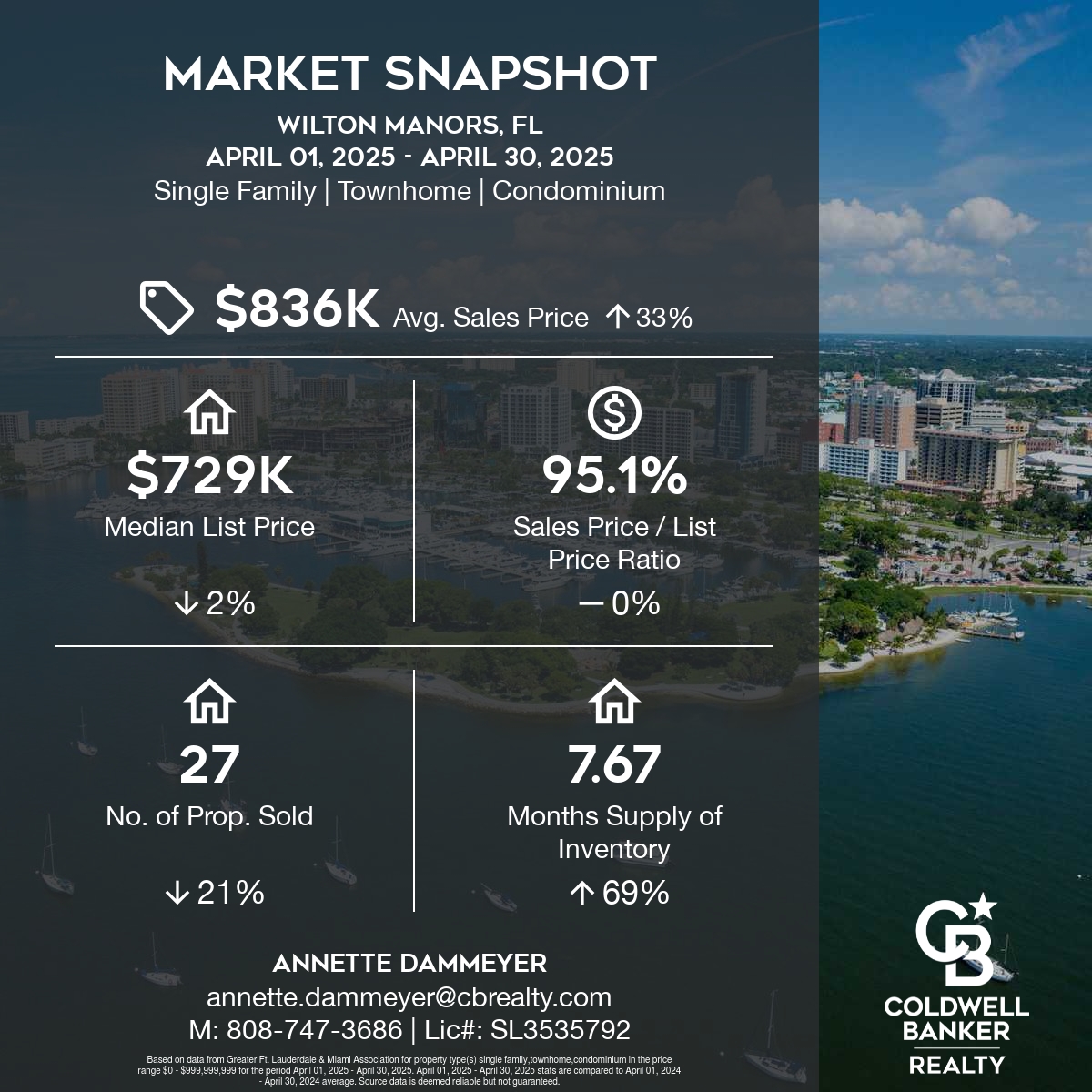
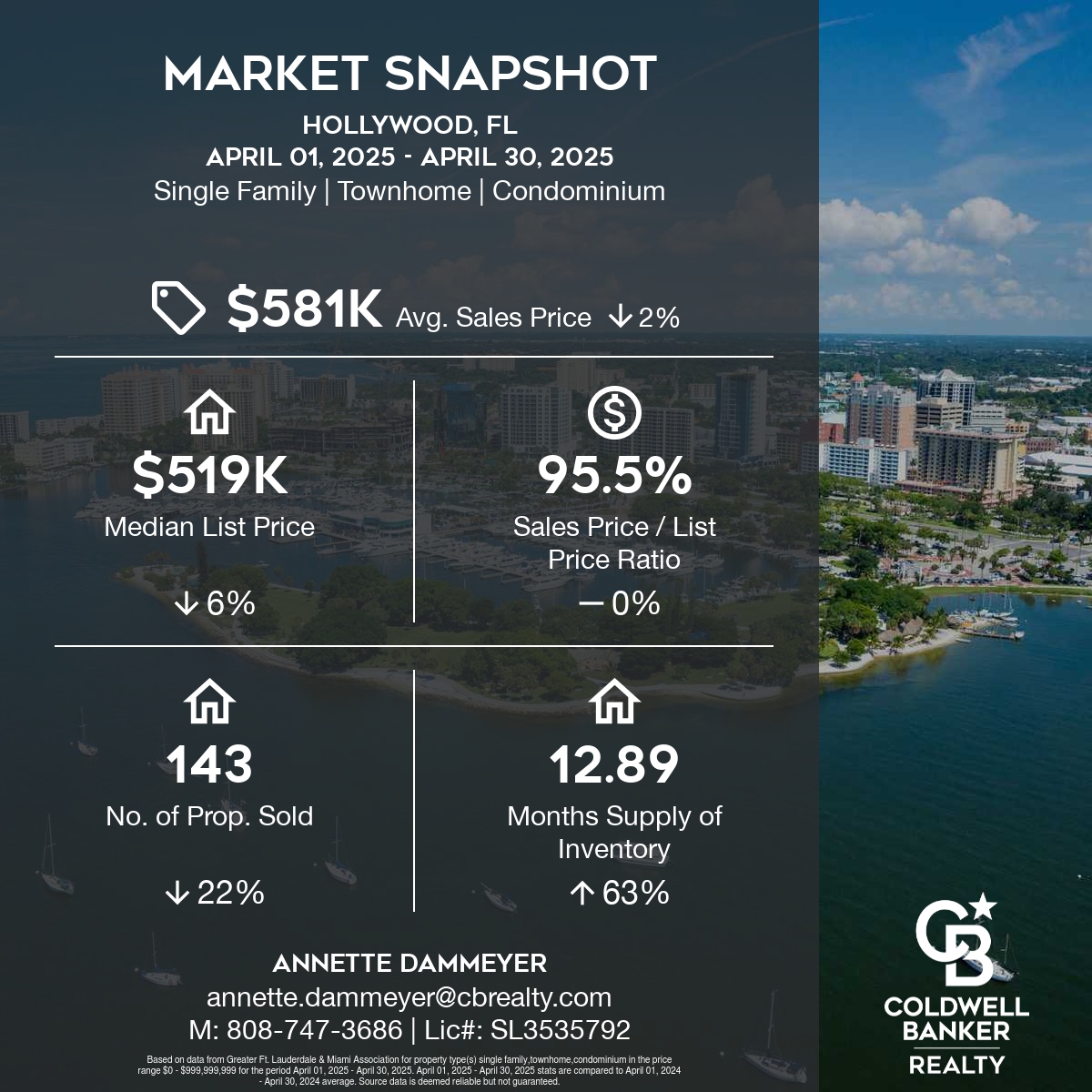
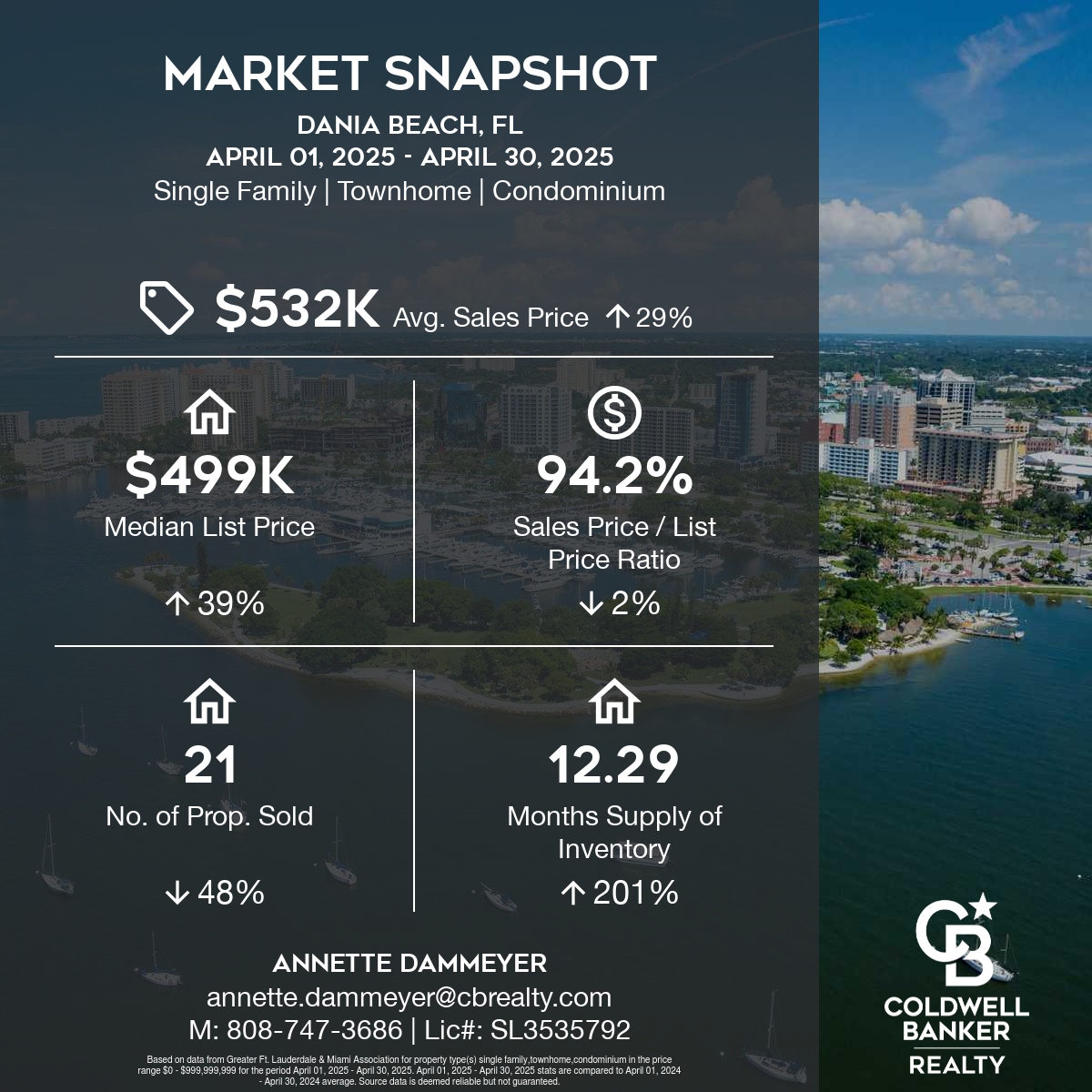
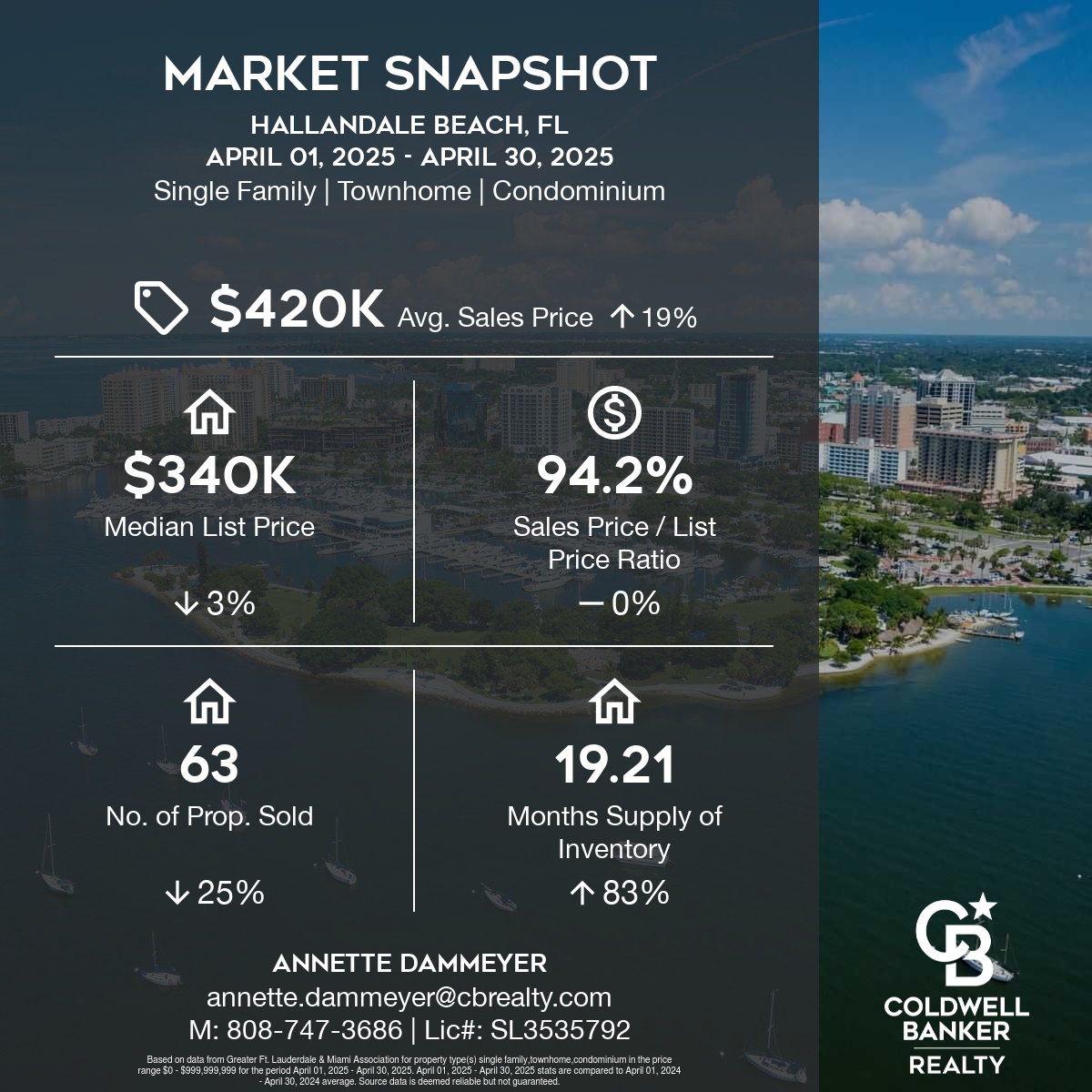
SE Florida Market Snapshot – April 2025
Market Trends in SE Florida
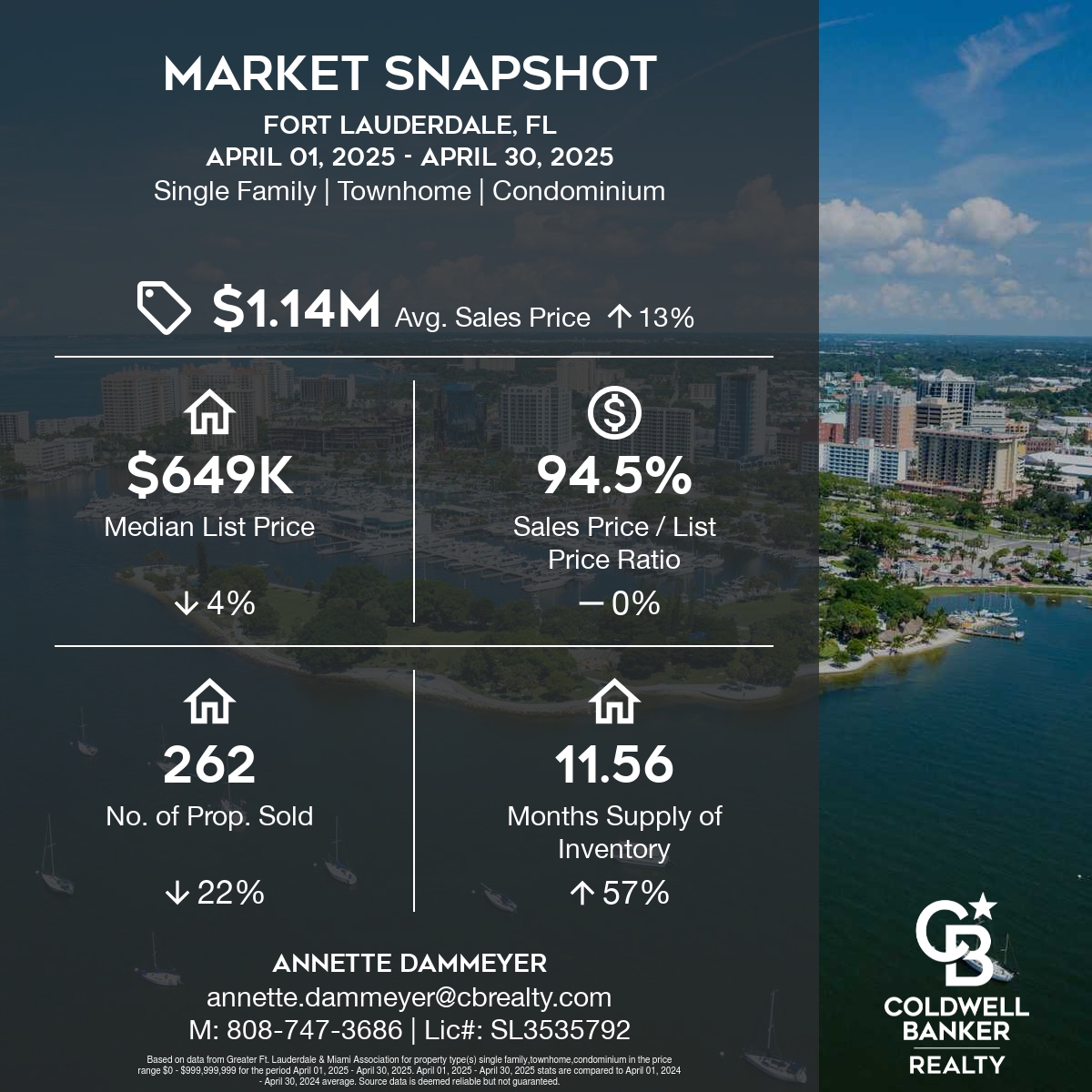
The real estate market is adjusting. The most obvious trends are fewer number of properties sold and the increase in months of supply of inventory, leaning towards a “buyer’s market”. Seller’s are now reassessing their asking price on their properties for sale. This is a great time to consider a decrease in asking price if the property has been on the market without active offers. I welcome any discussions you may want to have regarding your neighborhood or some of the headlines that have affected the real estate market. Please reach out to chat, even if you are not ready to buy or sell, but just would like to discuss current trends and updates. Here are the Market Snapshots reflecting the last month (compared to the same month last year) for the following areas:
- Fort Lauderdale
- Wilton Manors
- Hollywood
- Dania Beach
- Hallandale Beach
These take into account all property types (Single Family Homes/Condos/Townhomes).
With the rapidly changing real estate market, now is the time to make informed decisions. Contact me today to discuss the current market trends and how we can work together to accomplish your real estate goals. Please call or email me if you would like to be automatically sent detailed market reports for Fort Lauderdale, another SE Florida city, or your specific neighborhood. I am here to help.
CONTACT ANNETTE
Let’s start working together!
Annette Dammeyer, REALTOR®, ABR®, AHWD®
Coldwell Banker Realty
901 E Las Olas Blvd STE 101, Fort Lauderdale, FL 33301
808.747.3686
SL 3535792
The Do’s and Don’ts of Home Staging in SE Florida

The Do’s and Don’ts of Home Staging in Southeast Florida: A Local Realtor’s Tips to Selling Faster and Smarter
Hello friends and future sellers! If you’re preparing to sell your home in beautiful Southeast Florida, one of the most powerful tools you have at your disposal is home staging. As a real estate professional who’s helped many clients sell quickly and for top dollar, I can’t stress enough how much of a difference the right staging strategy can make—especially in our unique tropical market.
Buyers in SE Florida aren’t just shopping for a home; they’re often chasing a dream lifestyle. Whether they’re snowbirds, retirees, or families relocating for the sunshine, they’re picturing morning coffee on the lanai, ocean breezes through open windows, and bright, airy spaces. So let’s help them see that vision.
Here are my top Do’s and Don’ts of Home Staging in Southeast Florida:
________________________________________
DO: Embrace Natural Light

Why it matters: Florida sunshine is one of our biggest selling points! Buyers want bright, cheerful interiors.
Tips:
• Open all blinds and curtains before showings
• Wash windows inside and out for maximum sparkle
• Use mirrors strategically to reflect light and create a sense of space
________________________________________
DON’T: Overcrowd Your Furniture

Why it matters: Even spacious homes can feel cramped if there’s too much furniture.
Tips:
• Remove oversized or excess furniture
• Aim for open walkways and clear focal points
• Consider renting stylish, coastal-modern pieces
________________________________________
DO: Highlight Outdoor Living Spaces

Why it matters: Patios, pools, and lanais are golden in SE Florida real estate.
Tips:
• Stage outdoor areas with clean, inviting furniture
• Add greenery or colorful pillows for a resort-like vibe
• Power wash decks, clean pool tiles, and remove clutter
________________________________________
DON’T: Go Too Coastal and DO: Neutralize Bold Colors

Why it matters: While a beachy touch is great, going overboard can make your home feel kitschy instead of classy.
Tips:
• Think elegant coastal, not souvenir shop
• Stick with soft blues, whites, and neutrals
• Use subtle accents instead of heavy sea-themed decor
Why it matters: While tropical colors are fun, buyers need to picture their life in your space.
Tips:
• Repaint bright walls in soft, neutral tones
• Add color through accessories, not paint
• Let natural lighting and layout shine
________________________________________
DON’T: Forget the Smell Test

Why it matters: Our humid climate can bring unwanted odors, especially in older or coastal homes.
Tips:
• Use dehumidifiers to keep things fresh
• Avoid overpowering air fresheners
• Deep clean carpets and upholstery if pets live in the home
________________________________________
DO: Keep It Cool and Comfortable
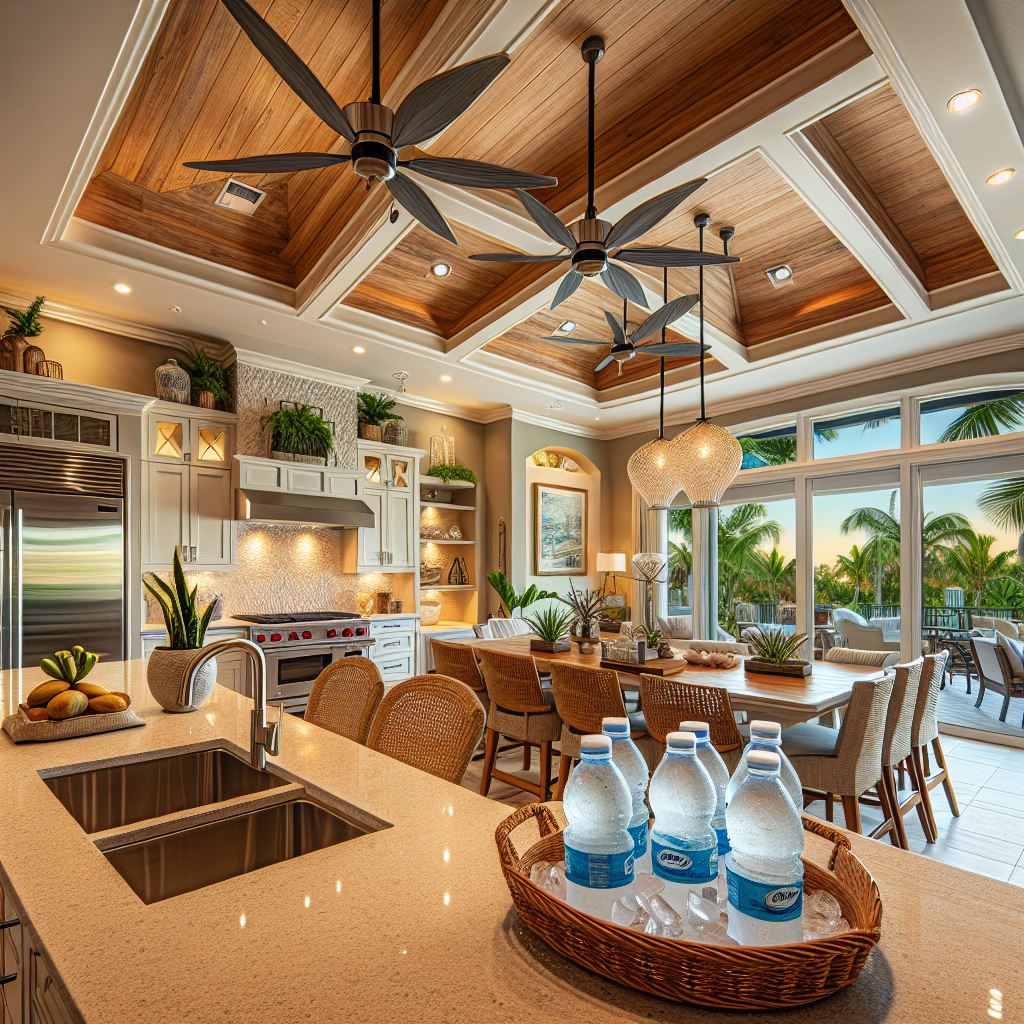
Why it matters: Buyers want to linger—and no one wants to linger in a hot, stuffy house.
Tips:
• Set the A/C to a comfortable 72–74°F
• Use ceiling fans for gentle air flow
• Offer bottled water during open houses
________________________________________
DO: Boost Curb Appeal
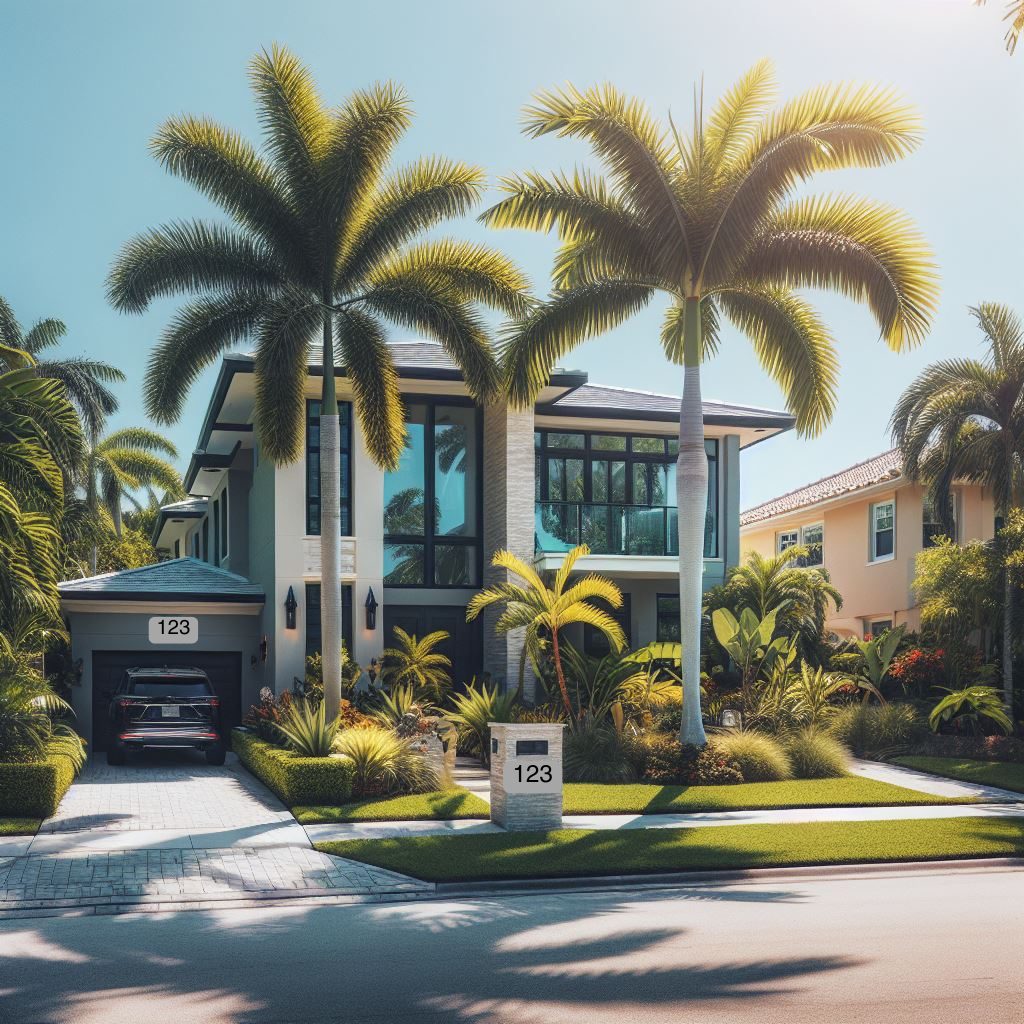
Why it matters: First impressions happen fast—often from the car window!
Tips:
• Freshen up landscaping with trimmed hedges, flowers, and a mowed lawn
• Add a new welcome mat or paint the front door
• Make sure house numbers are clean and visible
________________________________________
DON’T: Overlook Small Repairs

Why it matters: Buyers notice the little things—and they can signal bigger problems.
Tips:
• Fix leaky faucets, squeaky doors, chipped paint, or cracked tiles
• Replace burnt-out bulbs and tighten loose handles
• Even minor touch-ups can add big value
________________________________________
DO: Hire a Professional Cleaning Service

Why it matters: A truly spotless home feels more luxurious, cared-for, and move-in ready.
Tips:
• Deep clean bathrooms, kitchens, baseboards, and windows
• Don’t forget appliances—buyers open ovens, fridges, and even dishwashers
• A professional cleaning before listing is worth every penny
________________________________________
Selling a home in SE Florida is about more than just listing it—it’s about presenting a lifestyle. Proper home staging helps buyers fall in love from the moment they walk in. It tells them, “this is it—the Florida dream.”
If you’re unsure where to start or you’d like a to schedule a consultation, I’m always here to help. I’ve assisted many clients through the process to make their home shine.
CONTACT ANNETTE
Let’s start working together!
Annette Dammeyer, REALTOR®, ABR®, AHWD®

Coldwell Banker Realty
901 E Las Olas Blvd STE 101, Fort Lauderdale, FL 33301
808.747.3686
SL 3535792
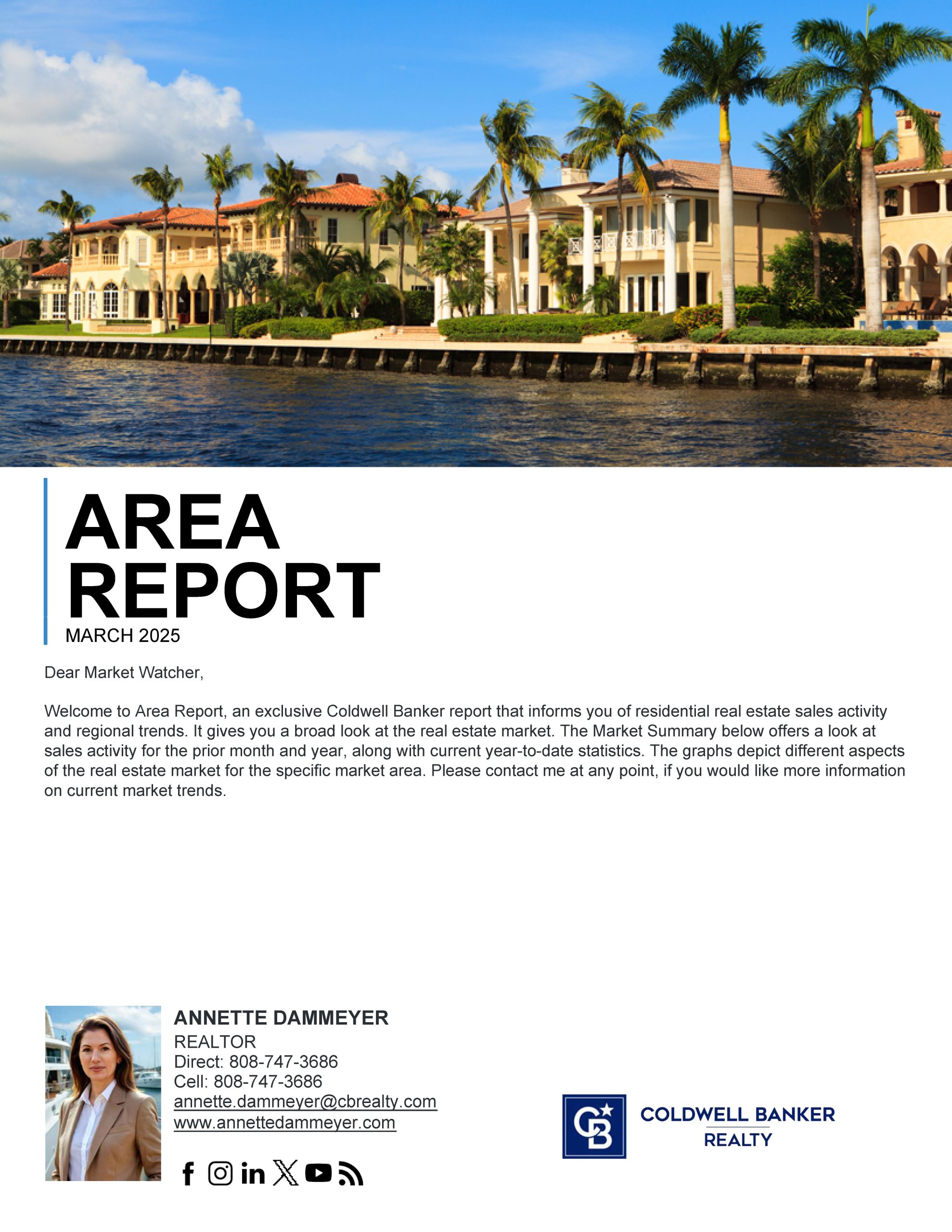
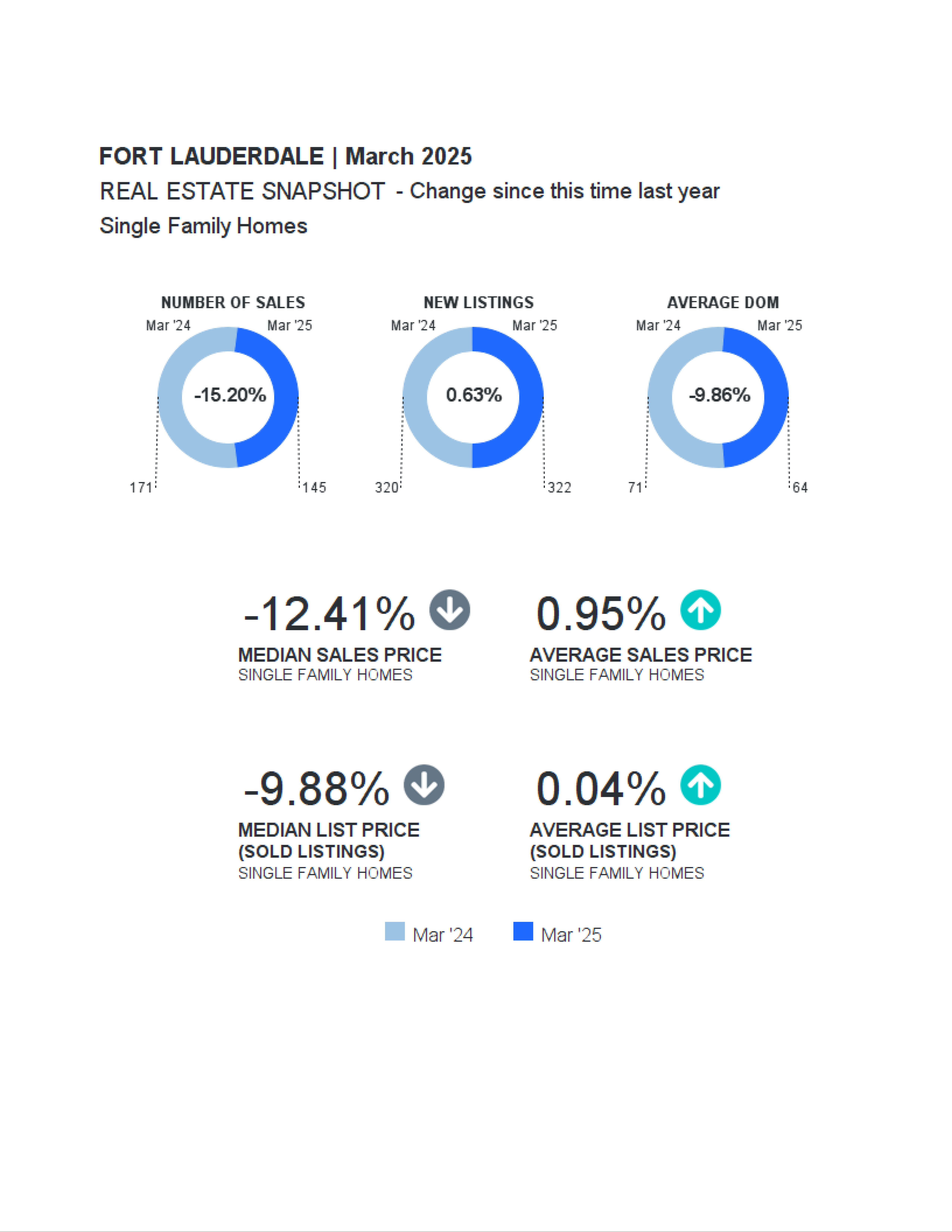
Fort Lauderdale March 2025 Area Report
Fort Lauderdale March 2025 real estate statistics have been released.
Fort Lauderdale Area Reports
Single Family Homes
Condominium & Townhouses
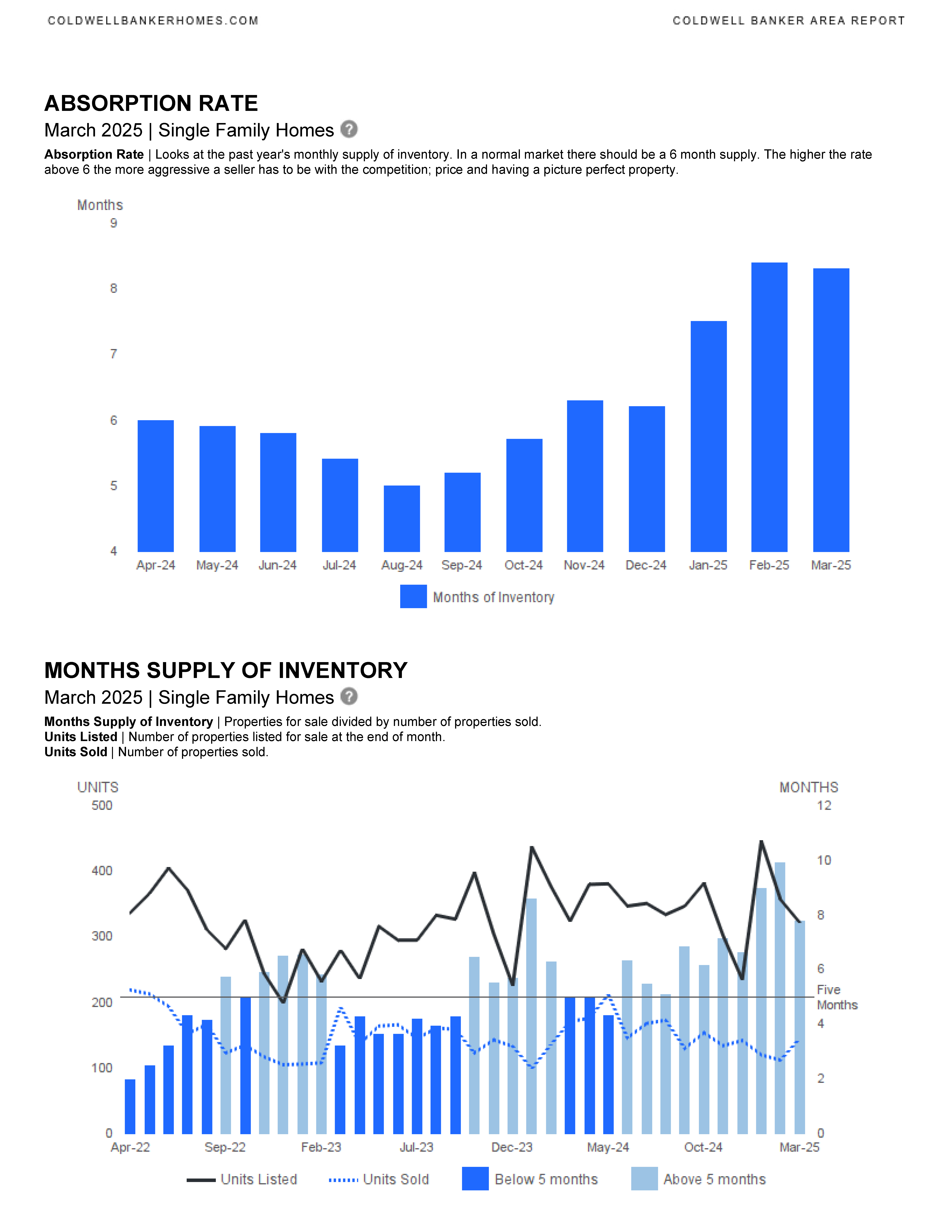
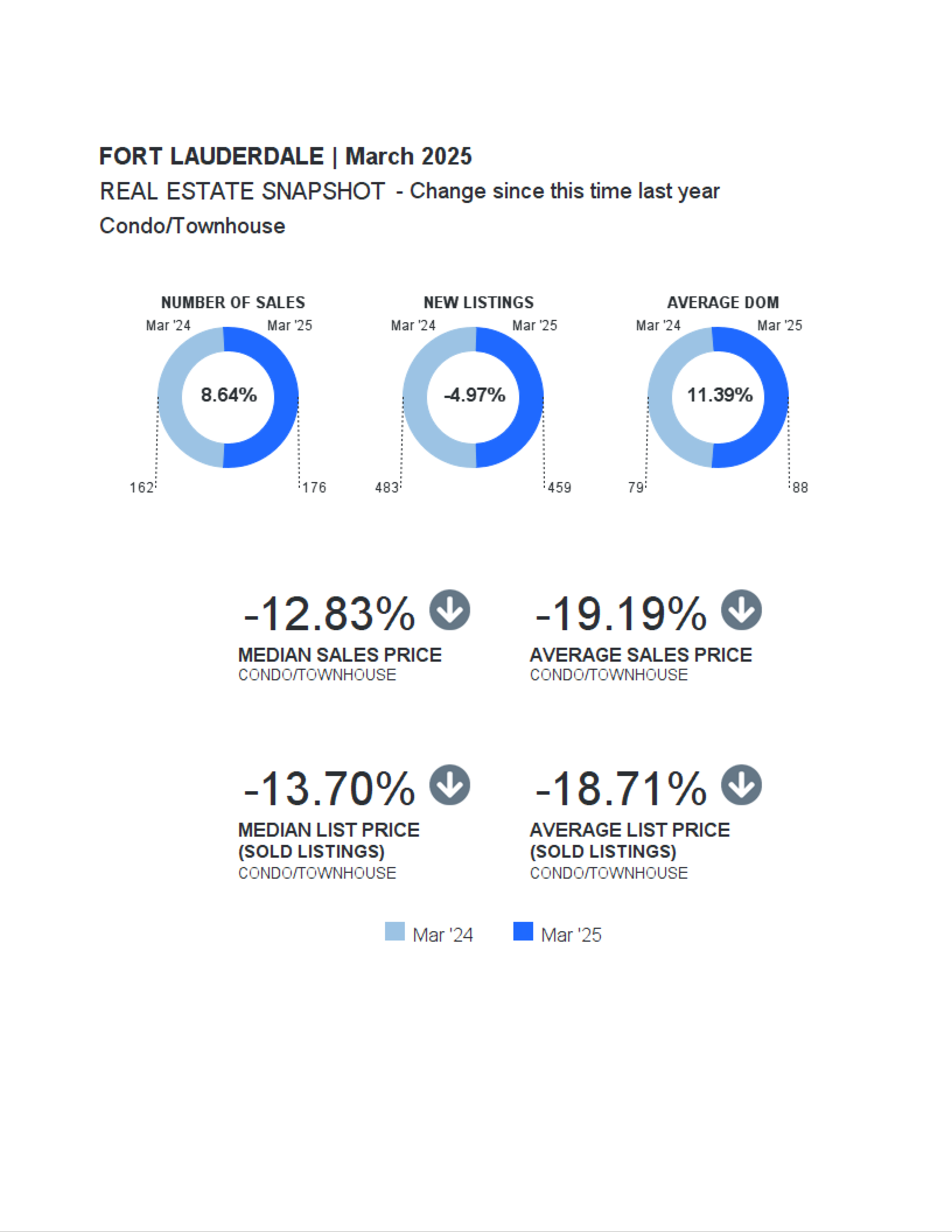
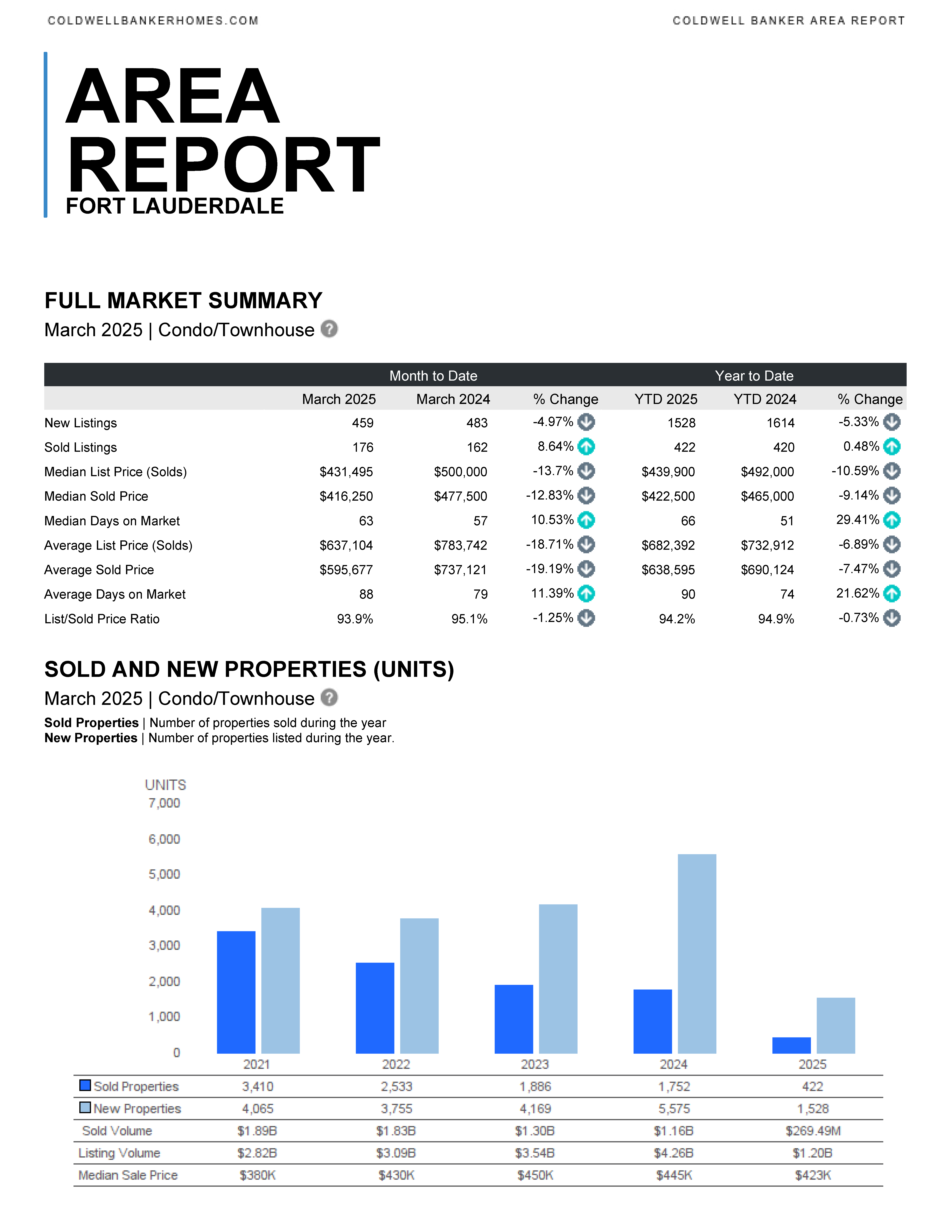
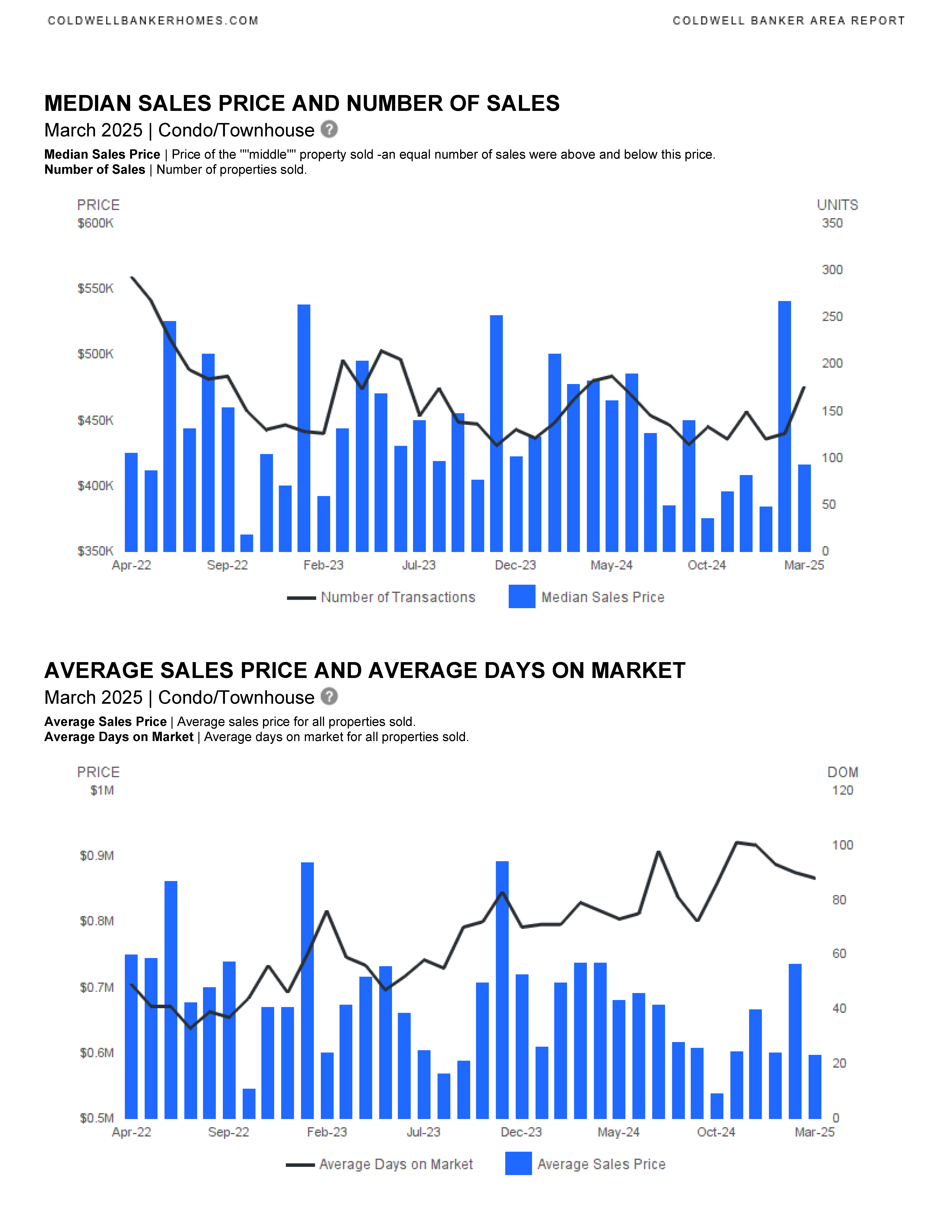
Commonly asked questions while reviewing the reports:
What is the difference between “Median Sales Price” and “Average Sales Price”?
Median Sales Price | Price of the “”middle”” property sold -an equal number of sales were above and below this price.
Average Sales Price | Average sales price for all properties sold.
What does “Absorption Rate” mean?
Absorption Rate | Looks at the past year’s monthly supply of inventory. In a normal market there should be a 6 month supply. The higher the rate above 6 the more aggressive a seller has to be with the competition; price and having a picture perfect property.
Single Family Home Area Report listed first, Condo/Townhouses listed second:
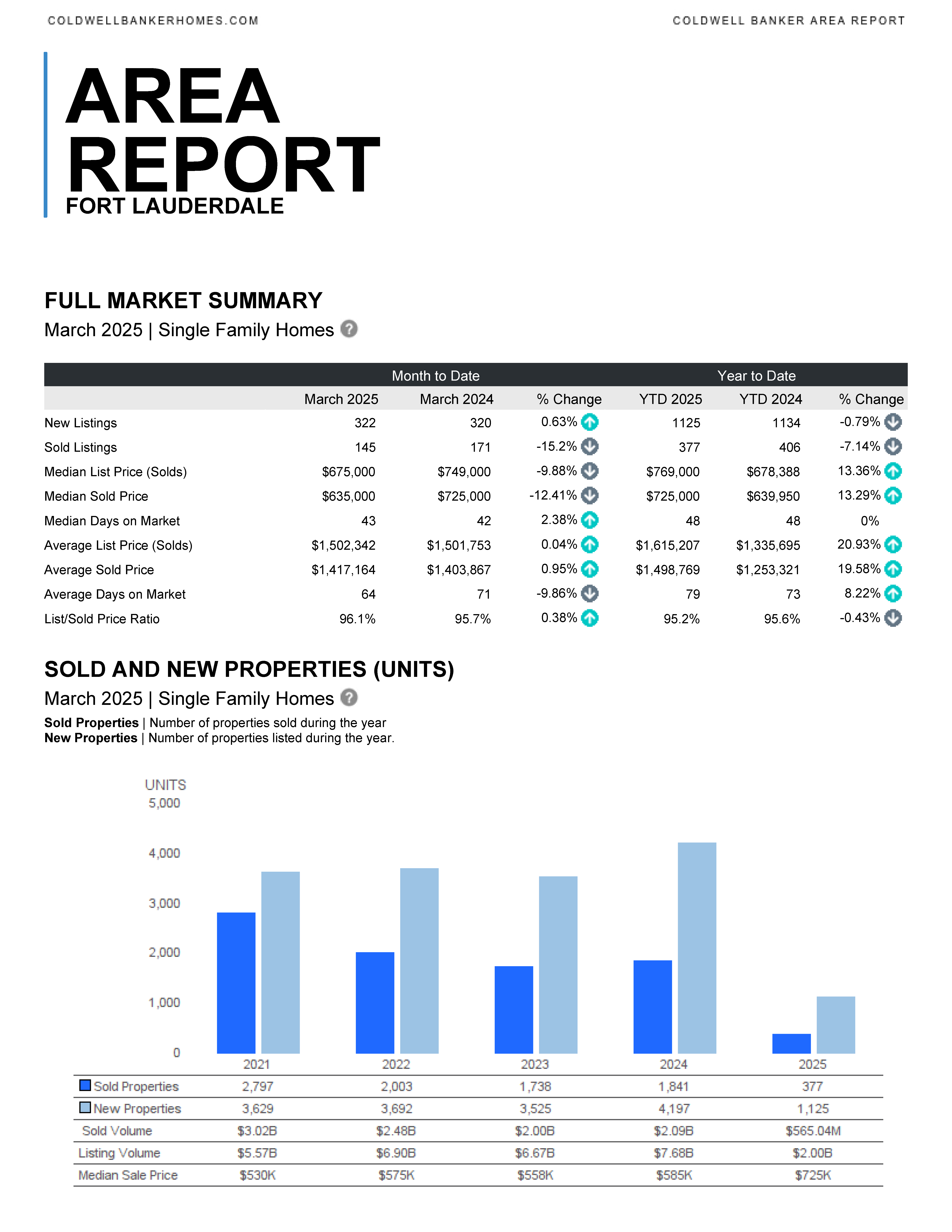
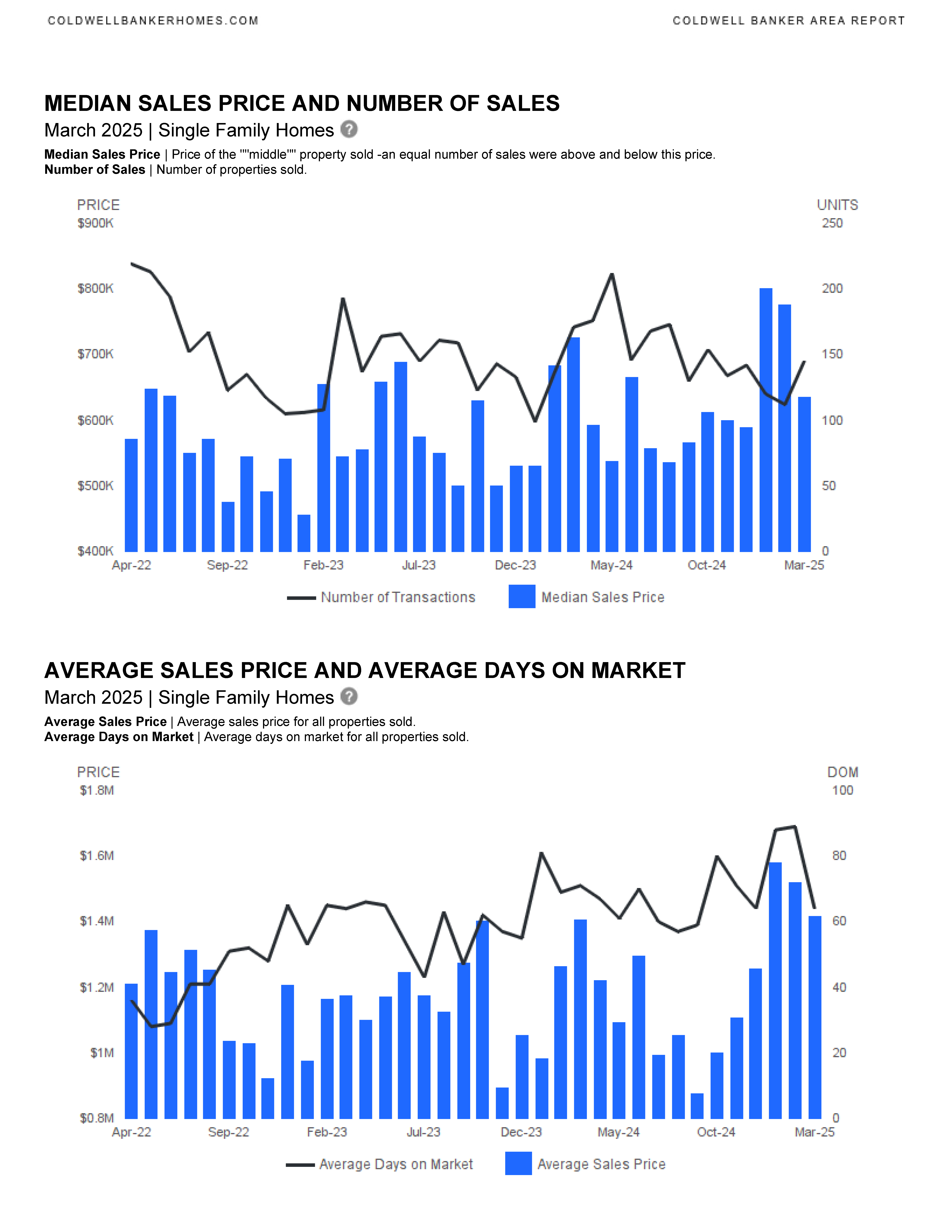
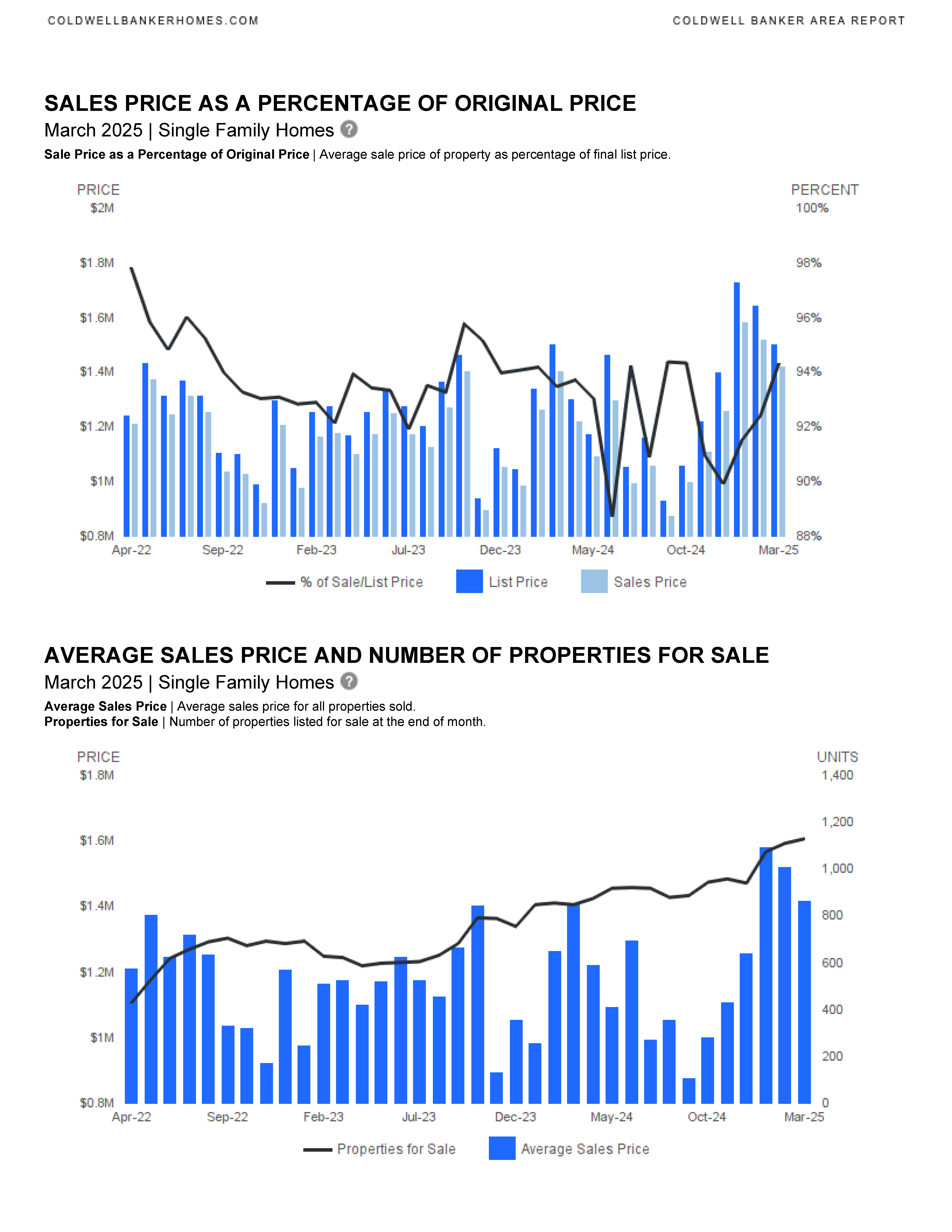
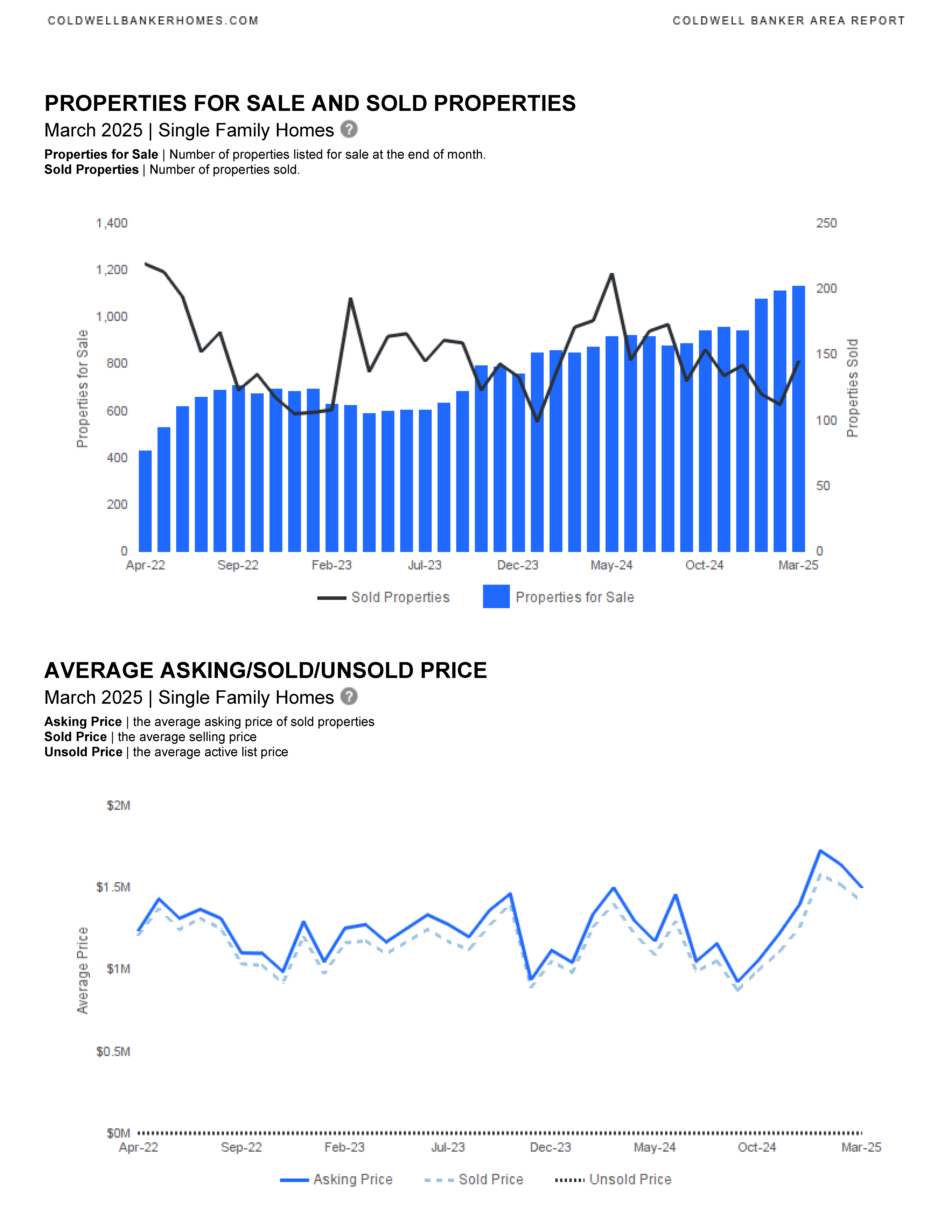
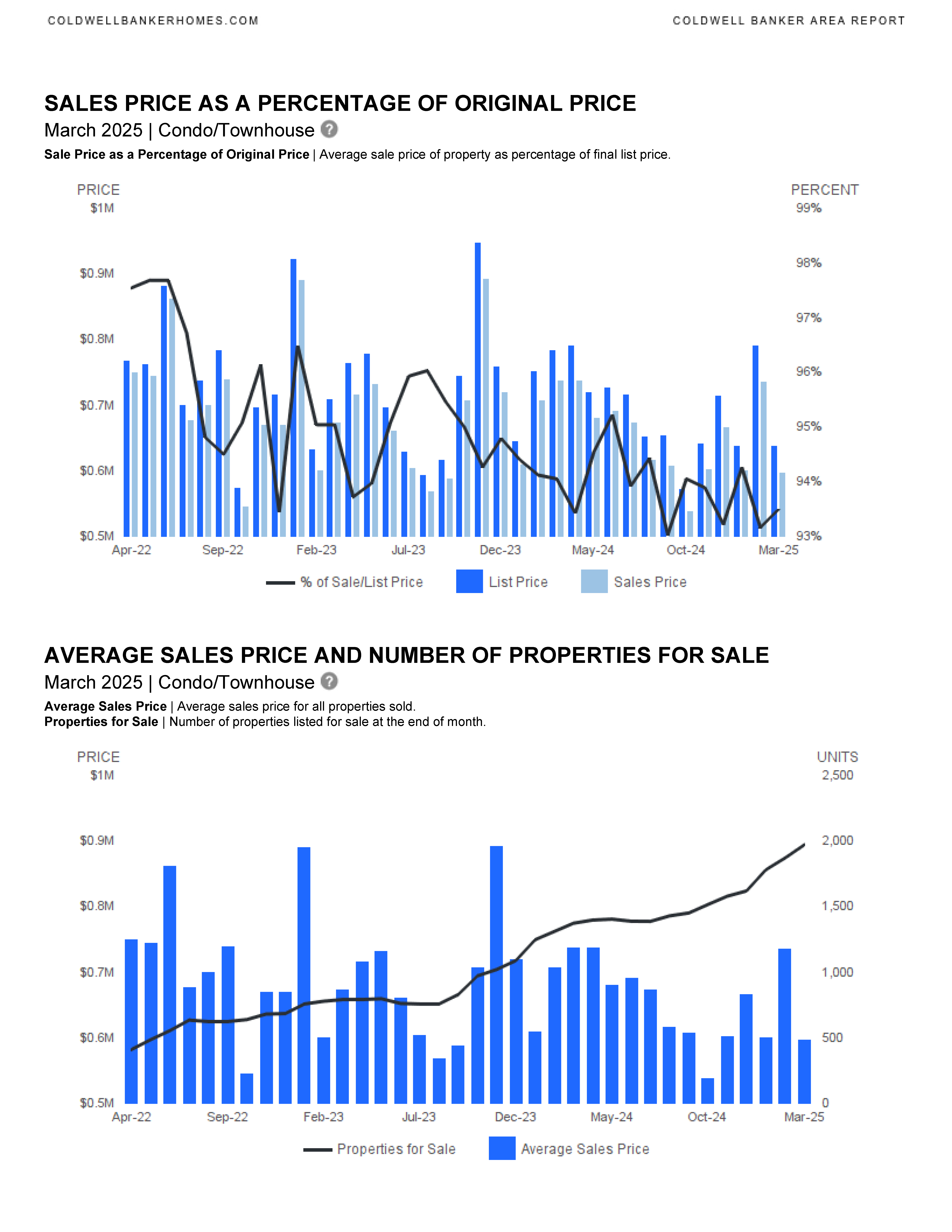
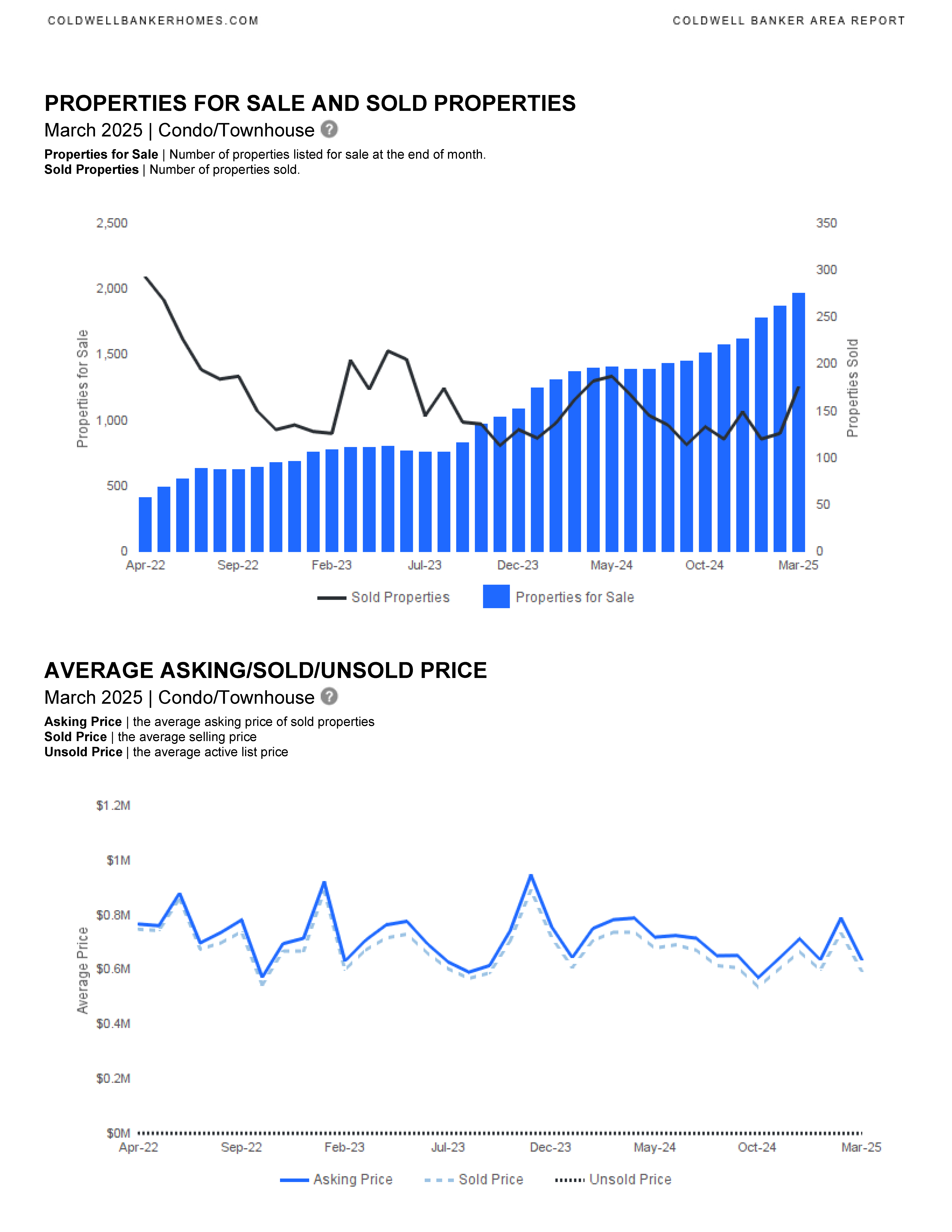
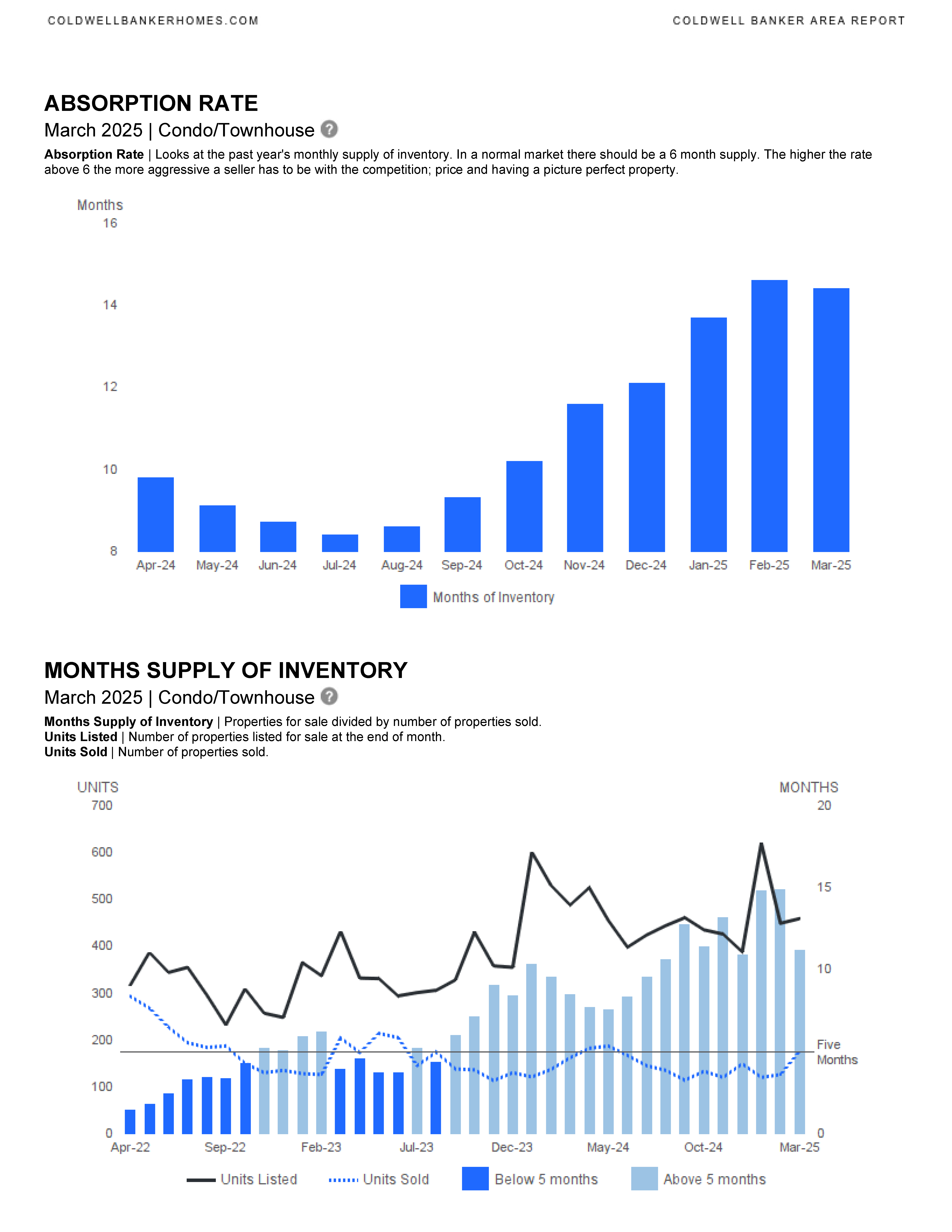

We are entering a new real estate market in SE Florida. This is the time to work with an experienced and knowledgeable real estate professional. Please contact me if you would like to be sent updated area market reports for Fort Lauderdale or another SE Florida city. We can discuss the market, current trends and how we can work together to accomplish your real estate goals. I am here to help.
CONTACT ANNETTE
Let’s start working together!
Annette Dammeyer, REALTOR®, ABR®, AHWD®
Coldwell Banker Realty
901 E Las Olas Blvd STE 101, Fort Lauderdale, FL 33301
808.747.3686
SL 3535792


